Answering your search for “tankless water heater costs,” this guide compares five popular, cost-conscious options to help you pick the best value for your home. Suitable buyers include new homeowners upgrading to on‑demand hot water, families seeking energy efficiency, and renters needing compact, portable solutions. The table below summarizes the selected options to jumpstart your comparison.
| Product | Type | Max Capacity | Notable Benefit |
|---|---|---|---|
| Rinnai RX199iN | Condensing Gas Tankless | Up to 11.1 GPM | Indoor/outdoor versatility; Smart Sense control |
| Westinghouse Smart Tankless Gas Indoor | Gas Tankless | Up to 10.3 GPM | WiFi App & Voice Control |
| Westinghouse 18kW Electric | Electric Tankless | Up to 4.2 GPM | Self-modulating, fast warm water |
| Rheem 18kW 240V | Electric Tankless | Up to 4.4 GPM | External digital thermostat, copper elements |
| AIYEZIDT 110V Under Sink | Electric Point‑of‑Use | Low flow (3kW model) | Ultra-compact; quick hot water at sink |
Rinnai RX199iN Condensing Tankless Water Heater

The Rinnai RX199iN is a versatile condensing tankless gas water heater rated for indoor or outdoor use with Versa Vent compatibility and Smart Sense gas control. It supports up to 11.1 GPM and up to 199,000 BTU, intended for households with multiple fixtures. Best for homeowners who want flexible installation and high hot-water capacity in moderate to large homes. A quick‑flush feature and high efficiency (UEF .98) are highlighted. A caveat: outdoor installations require the RX-OVC vent cap, and WiFi control via Controlr module is an optional add‑on (not included).
Westinghouse Smart Tankless Gas Indoor

This indoor gas tankless unit delivers up to 10.3 GPM and 199,000 BTU, designed for whole-home performance. It features a dedicated WiFi app and voice control for temperature management and fault alerts. Best for larger homes needing continuous hot water without pressure loss. Use caution with installation complexity and ensure your home’s gas supply and venting align with local codes.
Rheem 18kW 240V Tankless Electric Water Heater
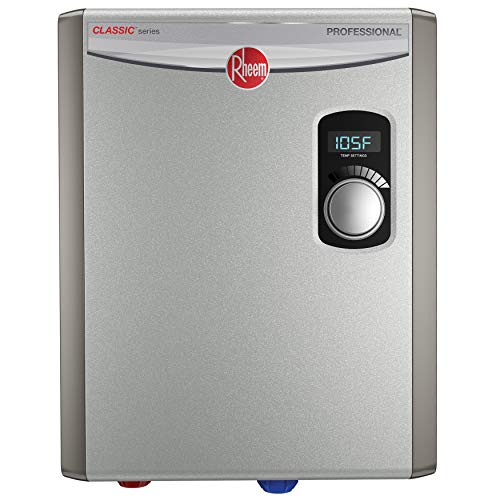
The Rheem electric model provides up to 4.4 GPM with durable copper heat elements and an external digital thermostat. Self-modulation helps adjust power to demand, supporting reliable hot water for busy households. Best for homes with adequate electrical capacity and a preference for copper heating. Limitation: actual flow rate may be lower at cooler inlet temperatures or with high simultaneous usage.
AIYEZIDT 110V Under Sink Instant Water Heater

This compact 110V under-sink unit provides instant hot water at the tap, ideal for kitchens or bathrooms with space constraints. It heats up to 55°C (131°F) and includes IPX4 waterproofing and safety protections. Best for point‑of‑use needs in small spaces. Caution: not suitable for shower use or high‑flow demands; flow and temperature depend on inlet water temperature.
Buying Guide: Tankless Water Heater Costs and How to Choose
- What affects initial installation costs? Size, venting or electrical requirements, and location (indoor vs outdoor) drive upfront price. Gas models often require venting and gas line work, while electric models depend on available amperage and space for electrical panels.
- How does operating cost vary? Gas models generally cost less per gallon of hot water in many regions, but energy efficiency and usage patterns matter. Electric units can be cheaper to install in some homes but may have higher operating costs under heavy use.
- What about efficiency ratings? Look for units with high energy factor or uniform energy factor (UEF) ratings. Higher values translate to less energy wasted during heating and better long‑term savings.
- Which size is appropriate for your home? Estimate the number of fixtures used simultaneously. Larger homes with multiple showers may require higher GPM capacity; smaller apartments can often manage with lower GPM or point‑of‑use solutions.
- Should you prioritize smart features? WiFi control, fault alerts, and remote monitoring can improve maintenance and comfort but may add upfront cost. Weigh these features against your budget and needed reliability.
Frequently Asked Questions
- What is a tankless water heater’s typical lifespan? Most systems are designed for 15–20 years with proper maintenance.
- Do tankless heaters save energy? Yes, by heating water on demand rather than keeping a tank hot, though savings depend on usage patterns and efficiency.
- Is professional installation required? For gas models, yes, due to venting and gas line work. Electric units may require a licensed electrician for panel upgrades.
- Can tankless units supply hot water for multiple fixtures? Yes, but capacity must be matched to peak flow needs; otherwise you may experience temp fluctuations.
- Are there safety concerns? Look for features like dry‑fire protection, IP ratings, and overheating protection to minimize risk.
- What about maintenance costs? Periodic flushing and routine inspections are advised, especially for gas models with mineral buildup.