Answer: For large, industrial spaces, choose high-CFM, weatherproof upblast exhaust fans with durable motors and corrosion-resistant housings. This guide highlights five strong options for warehouses, factories, restaurants, and commercial kitchens. Each product is evaluated for power, durability, noise, and ease of installation, so you can pick the best fit for your space. The top picks are best for open warehouses, kitchens with heat buildup, or areas needing reliable, long-term venting. A quick summary table is included to compare core specs and intended uses at a glance.
| Product | Best For | Key Strength |
|---|---|---|
| VEVOR Roof Exhaust Fan (500/900 CFM) | Medium warehouses, garages, kitchens | Adjustable airflow, aluminum housing |
| CXRCY 1400 CFM Upblast | Factories, warehouses, restaurants | All-copper motor, energy-efficient |
| PeakPursuit 1400 CFM Upblast | Commerical spaces needing quiet operation | Low-noise, weather-resistant |
| PrecisionAuto 2400 CFM | Large kitchens, warehouses | High airflow, direct-drive |
| SierraSquad 2400 CFM Upblast | Industrial settings, outdoor rooftops | Direct drive, weather resilience |
VEVOR Roof Exhaust Fan, 500/900 CFM

The VEVOR model combines a lightweight aluminum housing with a robust motor and two speed controllers. It provides 500 CFM or 900 CFM options, making it suitable for mid-sized garages, kitchens, and bathrooms where heat buildup or odors require prompt removal. Best for spaces where installation height and weight are considerations, and where energy efficiency matters due to dual-speed operation. Caution: ensure power supply and mounting hardware match the unit’s technical specs to avoid overloading the circuit.
CXRCY 1400 CFM Upblast Roof Exhaust Fan

CXRCY delivers a high 1400 CFM airflow with a full copper motor running at 2700 RPM and a low power draw of about 260W. The all-weather spun-aluminum housing plus waterproof design enhances durability for warehouses, factories, and restaurant kitchens. Best for facilities requiring strong air exchanges while controlling energy use. Consider this option if you need a reliable, energy-conscious unit capable of continuous operation in challenging conditions.
PeakPursuit 1400 CFM Upblast Roof Exhaust Fan

PeakPursuit emphasizes high airflow with 1400 CFM and a direct-drive motor, designed for commercial and industrial ventilation. It also highlights low-noise operation and weather-resistant components. Best for restaurants or workspaces where reducing ambient noise matters, while still achieving strong air movement. A limitation to watch is that higher airflow often accompanies higher energy usage; confirm it aligns with energy goals for your space.
VEVOR Roof Exhaust Fan, 900 CFM & 1500 CFM
This VEVOR unit expands to 900 CFM or 1500 CFM, ideal for larger garages, kitchens, or warehouses needing aggressive exhaust. It uses a 220W motor with speeds at 1572 and 2200 rpm for flexible ventilation. Best for spaces where energy efficiency matters alongside high airflow. Choose this if you anticipate scalable needs as your space expands; beware of potential higher noise at top speeds.
PrecisionAuto 2400 CFM Industrial Upblast
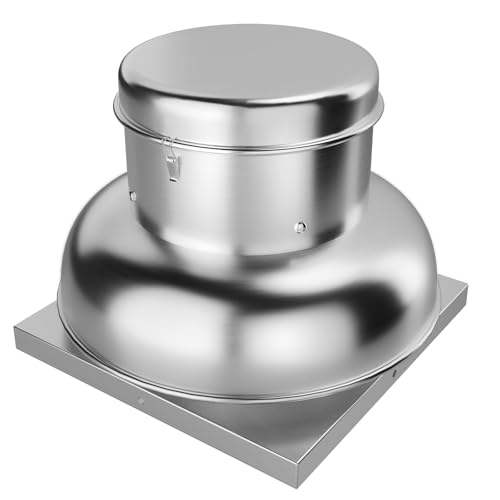
PrecisionAuto’s 2400 CFM unit is built for demanding environments like large kitchens and warehouses. It uses a direct-drive motor approach to reduce maintenance and ensure consistent high-speed performance. Best for facilities prioritizing maximum ventilation output with fewer moving parts. A caution is that higher power units may require robust electrical support and secure mounting.
SierraSquad 2400 CFM Upblast

SierraSquad 2400 CFM offers strong air movement with a direct-drive design and weather-resistant housing. It’s well-suited for outdoor rooftop installations and heavy-duty ventilation roles in industrial spaces. Best for facilities needing robust performance in variable weather. Limitation to note: installation may require professional assessment to ensure proper drainage and secure mounting on roof structures.
Buying Guide: Key Purchase Considerations
- Airflow needs: Match CFM to space size and ceiling height. Larger areas generally require 1200–2400 CFM or more.
- Motor type: Direct-drive motors offer fewer moving parts and lower maintenance, but may have higher upfront costs.
- Durability and weather resistance: Look for weatherproof housings, corrosion-resistant materials, and waterproof designs for outdoor rooftops.
- Power and energy use: Evaluate wattage and RPM to balance ventilation speed with energy efficiency.
- Noise considerations: For dining areas or occupied spaces, prioritize low-noise models or designs with noise-reduction features.
- Installation and mounting: Ensure compatibility with roof structure, mounting hardware, and electrical supply. Some models require professional installation.
- Maintenance: Consider accessibility of blades and components for cleaning and preventive maintenance.
- Environment: Kitchens with steam, grease, or high humidity benefit from corrosion-resistant materials and sealed housings.
Frequently Asked Questions
- What is CFM and why does it matter for a warehouse roof exhaust fan?
– CFM stands for cubic feet per minute and measures how much air the fan can move. Higher CFM is better for larger or more humid spaces to remove heat, smoke, and odors quickly. - Is a copper motor more durable than aluminum in roof exhaust fans?
– Copper motors are typically durable and efficient; however, overall durability also depends on housing, seals, and installation quality. - Should I choose a direct-drive or belt-drive fan?
– Direct-drive reduces maintenance and components that wear, making it a common choice for continuous operation in commercial settings. - Do I need weatherproofing for rooftop exhaust fans?
– Yes. Outdoor rooftop installations benefit from weatherproof, waterproof housings to withstand rain and debris. - How do I estimate the right CFM for my space?
– Measure the room volume (length × width × height) and multiply by the desired air exchanges per hour. Divide by 60 to convert to CFM, then select a fan with equal or higher CFM than calculated. - Can these units be installed in kitchens or restaurants?
– Yes, many models are designed for commercial kitchens and restaurants, but verify grease resistance and local code compliance for exhaust ventilation.