Whether upgrading an existing hydronic system or exploring renewable-energy integration, choosing the right water-to-air or water-to-water heat exchanger is essential. This guide highlights five top picks suited for residential heating, space cooling, and light commercial use. Each option is evaluated for energy efficiency, build quality, and practical suitability for different setups. The top picks are best for homeowners seeking durable, maintenance-friendly units and for buyers prioritizing high heat-transfer performance without excessive power use.
Buyer overview table
- Product: AB Water to Air Heat Exchanger 20×20 (Outdoor Wood Furnaces, Residential Heating and Cooling)
- Product: AB Water to Air Heat Exchanger 12×15 (Outdoor Wood Furnaces, Residential Heating and Cooling)
- Product: BestEquip Heat Exchanger 3″x7.5″ 60 Plates
- Product: VEVOR Brazed Plate Heat Exchanger, 80 Plates
- Product: AB Plate Heat Exchanger, 4″x12″ 30 Plates
AB Water to Air Heat Exchanger 20×20

Best for: Homes requiring robust outdoor heat exchange with multiple renewable-energy integrations. Designed for wood-fueled setups and forced-air systems, it supports energy-efficient heat transfer through copper ports and a steel shell. The unit’s 12 aluminum fins and triple 3/8″ copper-tube rows offer strong performance and durability.
Why selected: This model balances premium materials with a high-capacity design (up to 360 kBtu/h in certain applications) and extended service life thanks to epoxy-coated fins and base-brazed joints. Suitable when you want a durable exterior unit that can operate under higher temperatures and pressures.
Caution: High-capacity performance depends on compatible installation and source heat availability. Ensure your system can feed the exchanger without excessive pressure drop.
AB Water to Air Heat Exchanger 12×15
Best for: Mid-size residential installations where space is a factor and you still want efficient heat exchange. This unit emphasizes strong heat-transfer performance with similar copper-tube/finned design and durable steel shell construction.
Why selected: Offers reliable performance with a compact footprint, making it a good fit for homes upgrading to enhanced outdoor- or boiler-assisted heating and cooling. Its configuration supports renewables combined with conventional sources.
Caution: Matching the exchanger to your existing ductwork and circulator pump is important to realize the stated performance benefits.
BestEquip Heat Exchanger 3″x7.5″ 60 Plates

Best for: Applications requiring high thermal efficiency in compact form, such as small commercial setups or hobbyist projects that need effective heat transfer without a large footprint.
Why selected: Turbulent flow and asymmetric fins deliver strong heat transfer, with robust 316L stainless construction. It can operate across a wide temperature range and is designed for reliable performance in demanding environments.
Caution: This unit relies on a proper brazed-plate assembly; ensure installation follows guidelines to prevent leaks or pressure issues.
VEVOR Brazed Plate Heat Exchanger, 80 Plates
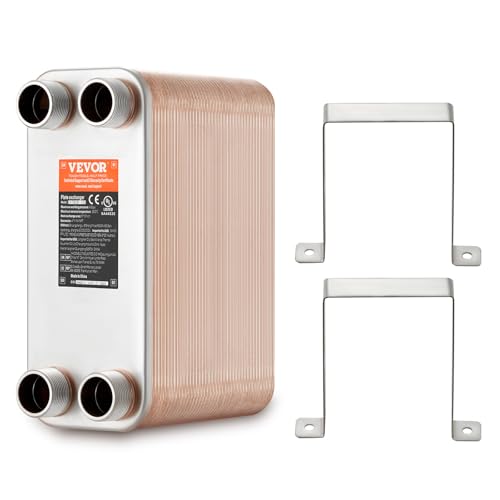
Best for: Systems that demand high heat-transfer capacity in a compact, modular package. This unit is well-suited for floor heating and water heating with potential snow-melt applications.
Why selected: 316L stainless steel with copper brazing yields strong reliability and corrosion resistance, while an asymmetrical plate design increases turbulence for efficient energy use. Large plate count provides substantial heat-exchange area.
Caution: The high plate count increases the potential for installation complexity; ensure proper flow routing and gasket-less brazing integrity if used in high-pressure lines.
AB Plate Heat Exchanger, 4″x12″ 30 Plates

Best for: Larger residential or light commercial hydronic systems needing a balanced mix of size and heat-transfer efficiency. The 30-plate configuration provides substantial capacity per unit size.
Why selected: Combines 316L stainless steel with copper-edge brazing for durable construction and high pressure resistance. The smooth thread and compact form make for easier hookup in retrofit or new installations.
Caution: Ensure plumbing connections and pumps are sized to achieve the target BTU range; undersized pumps can reduce efficiency gains.
Buying Guide
- What heat-transfer method do I need? Water-to-air exchangers are ideal for forced-air heating and cooling, while water-to-water units suit radiant or hydronic loops.
- What materials matter most? Look for stainless steel (316L) bodies and copper brazing for durability and corrosion resistance in challenging environments.
- How many plates or fins do I need? More plates or fins generally increases heat-transfer area, but also space, cost, and pressure considerations.
- What is the operating temperature and pressure range? Verify compatibility with your system’s maximum temperatures and circulating pressures to avoid leaks or reduced efficiency.
- Do I need compatibility with renewable sources? Exchangers labeled as energy-efficient or designed for solar or boiler integration can maximize energy savings.
- Installation considerations: Ensure appropriate clearances, mounting, and line sizes. Brazed-plate units require careful torqueing and leak checks during setup.
Frequently Asked Questions
- What is a heat exchanger used for in heating systems? It transfers heat between two fluids without mixing them, improving overall system efficiency.
- Are brazed plate heat exchangers better than shell-and-tube? Brazed plate units are compact and efficient, ideal for residential and light commercial use; shell-and-tube is often used for larger industrial applications.
- Can I install a heat exchanger in an existing boiler system? Yes, but proper sizing, flow control, and safety checks are essential for performance and reliability.
- What maintenance do these exchangers require? Regular inspections for leaks, corrosion, and flow restrictions; periodic cleaning or flushing as needed by the working fluid.
- How do I choose between water-to-air and water-to-water exchangers? If you want space heating via air ducts, choose water-to-air; for radiant floors or hydronic loops, choose water-to-water.
- Is bigger always better for a heat exchanger? Not necessarily. Select based on system flow, available space, and expected BTU load to avoid pumping inefficiency.