Answering the top buyer question: a water-to-water heat exchanger is best for transferring heat between two water circuits in heating, cooling, or process applications. This guide highlights five reliable options and explains who each one is best for, based on capacity, materials, and design. Ideal buyers include home installers seeking floor heating upgrades, commercial operators managing snow-melting or radiant systems, and industrial facilities needing robust heat transfer with minimal energy use. Below is a quick buying table followed by detailed product sections and a practical buying guide.
| Product | Brand | Approx. Capacity | Key Benefit |
|---|---|---|---|
| VEVOR Brazed Plate Heat Exchanger EATB28-80 | VEVOR | 780-1080K BTU/hr | High heat transfer with copper edges; robust 316L stainless steel |
| AB Plate Heat Exchanger 4″x12″ 30 Plates | AB | 250,000–330,000 BTU/hr | High plate count for strong transfer; convenient smooth thread |
| ALECOIL 3″x8″ 16 Plates | Alecoil | 121,000 BTU/h | Asymmetric fish bone design; efficient turbulence |
| ALORAIR 4″x12″ 30 Plates | ALORAIR | Not stated here | Premium SS316L with copper brazing; strong heat transfer |
| ALECOIL 5″x12″ 50 Plates | Alecoil | 748,000 BTU/h | Largest plate count among selections; strong performance |
VEVOR Brazed Plate Heat Exchanger
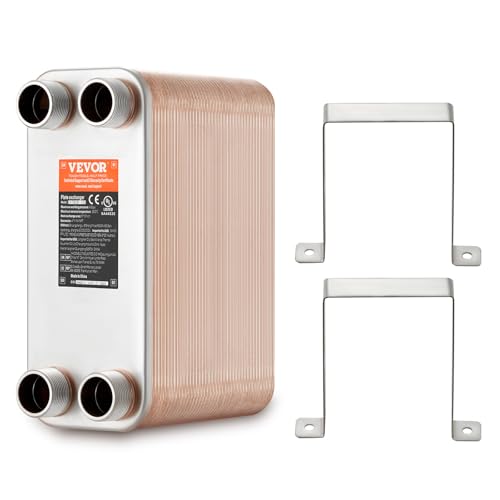
Best for: Users needing a compact, high-efficiency unit capable of large heat transfer in heating, cooling, or beer processing. This model uses 316L stainless steel with copper brazing at edges to form a leak-resistant assembly. It achieves up to 99% heat efficiency and can generate 780-1080K BTU per hour. Suitable for floor heating, water heating, snow melting, and process cooling. Caution: ensure compatible pump and pressure ratings for your system, as high-temperature and high-pressure operation is implied by material quality.
AB Plate Heat Exchanger, 4″x12″ 30 Plates

Best for: Applications needing a balance of capacity and economy for floor heating or water heating. The unit uses 316L stainless steel with copper-brazed edges for durability and leak resistance. It supports 250,000–330,000 BTU per hour depending on setup. The smooth-thread connections simplify installation and maintenance. Limitation: higher plate counts can require more space and careful piping layout.
ALECOIL 3″x8″ 16 Plates

Best for: Small to mid-size residential or light commercial heating projects where higher turbulence improves heat transfer without excessive pumping. This brazed plate exchanger uses 316L stainless steel with copper brazing and a fishbone pattern to boost heat transfer while reducing secondary-side pressure. Capacity around 121,000 BTU/h. Limitation: smaller footprint means lower total capacity; plan for future expansion if heat load grows.
ALORAIR 4″x12″ 30 Plates
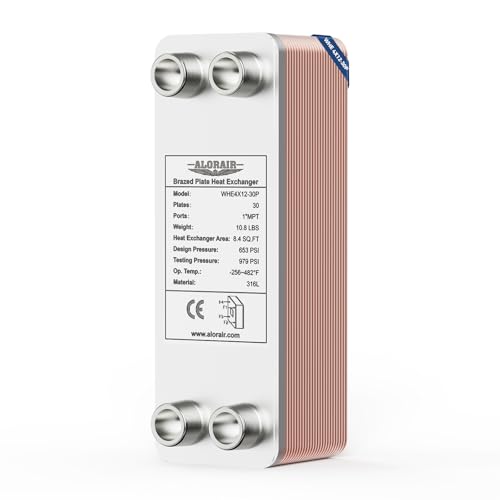
Best for: Users seeking robust stainless steel construction with copper brazing for refrigeration, floor heating, or high-temperature processes. The fishbone design enhances turbulence for rapid heat transfer, and the smooth threaded connections support quick installation. Capacity characteristics suggest strong performance in mid-range applications. Caution: verify available space for 4″x12″ plate dimensions in tight installations.
ALECOIL 4″x12″ 30 Plates

Best for: Medium-to-large heating or cooling setups needing higher BTU/h, with 30 plates and 1″ MPT ports. The design emphasizes efficient heat transfer via asymmetric fishbone plates and copper brazing. It offers strong performance while aiming to reduce pump load. Limitation: higher capacity units may require more careful pump sizing and loop balancing.
ALECOIL 5″x12″ 50 Plates

Best for: Large, industrial or commercial processes requiring very high heat transfer capacity. The 5″x12″ plate with 50 plates delivers up to 748,000 BTU/h capacity with a broad heat-transfer area, making it well-suited for demanding heating, floor heating networks, or refrigeration loops. Caution: this is a high-capacity unit; ensure compatible piping, space, and pump sizing.
Buying Guide
What should I consider when choosing a water-to-water heat exchanger?
Key factors include heat transfer area, plate count, port size, and material. A larger plate count and transfer area typically mean higher capacity. Stainless steel 316L with copper brazing provides durability and leak resistance, but trade-offs include size and cost.
How do I match capacity to my application?
Estimate the total heat load (BTU/hr) and select a unit with a capacity that covers peak demand with some margin. For radiant floor heating, consider the system’s temperature rise and flow rate. For snow-melting or industrial processes, ensure the exchanger can handle repeated high-temperature cycles.
What maintenance considerations matter?
Look for units with robust sealing, corrosion resistance, and easy assembly. Regular inspection of gaskets and connections, plus compatible cleaning procedures, helps maintain efficiency. Copper brazing at edges supports leak resistance, but periodic checks remain prudent.
Which design features improve efficiency?
Asymmetric fishbone plate designs improve turbulence, increasing heat transfer and reducing secondary-side pressure drop. This allows smaller pumps and lower energy use. Copper brazing with 316L stainless steel provides strong thermal and mechanical properties.
Installation and compatibility questions
Verify port sizes (MPT), overall dimensions, and mounting options fit your installation space. Smooth-thread connections simplify hookup, but confirm the thread type and sealant requirements for your piping system.
How to compare products quickly?
Use a side-by-side comparison of BTU/h capacity, plate count, heat-transfer area, material quality, and port sizing. Prefer units with higher heat transfer area and robust materials for demanding environments, but balance with space and cost considerations.
FAQ
- What is a water-to-water heat exchanger used for?
It transfers heat between two water circuits, commonly used in radiant floor heating, snow-melt systems, and industrial cooling or heating processes.
- Why choose a brazed plate exchanger over other types?
Brazed plate units offer compact size, strong heat transfer, and leak resistance due to copper brazing and stainless steel plates.
- What does plate count indicate?
A higher plate count generally means greater heat transfer area and higher potential BTU/hr capacity, but also larger size and weight.
- Are these units suitable for high-temperature applications?
Yes, many models are rated for wide temperature ranges, but always check the specified operating limits for your system.
- Which material is best for corrosion resistance?
316L stainless steel with copper brazing is widely used for corrosion resistance and durability in hot-water applications.