Choosing the right well house heater is essential for protecting pumps, pipes, and equipment in frigid environments. The following products are selected for reliability, safety, and performance in utility rooms, pump houses, and related outbuildings. Each option offers features tailored to prevent freezing, maintain steady temperatures, and operate with simple controls. Use this guide to compare heat output, safety protections, and installation practicality to find the best fit for your well house needs.
style=”display:none;”>Summary Table of Selected Products
| Product | Brand | Type | Key Features | Wattage |
|---|---|---|---|---|
| AEGONAN Utility Heater with Built-In Thermostat | AEGONAN | Convection Heater | Freeze protection; built-in thermostat; aluminum fins for heat transfer | 600W |
| Qmark WHT500 Utility Heater for Well Houses | Fahrenheat | Utility Heater | Pipes protection; durable galvanized steel; tamper-proof thermostat | 500W |
| Shinic Space Heater Milkhouse | Shinic | Milkhouse/Utility Heater | All-metal housing; 1500W/1300W options; tip-over and overheat protection | 1500W |
| TRUSTECH Greenhouse Heater | TRUSTECH | Greenhouse/Outdoor Heater | 3S heat; 3 modes; overheat protection; 90° tilt | 1500W |
| BEYOND HEAT Milkhouse Heater | BEYOND HEAT | Milkhouse Heater | 3 heat settings; anti-overheat and tip-over safety; ETL certified | 1300-1500W |
AEGONAN Utility Heater With Built-In Thermostat

AEGONAN’s HPA600 is designed for pump houses and utility spaces requiring reliable freeze protection. Its built-in thermostat helps maintain steady temperatures without constant manual adjustments. The heater uses a convection approach with X-shaped aluminum fins to maximize heat transfer across a larger surface area, promoting quicker, more uniform warmth. This minimal-maintenance unit has no moving parts prone to wear, making it suitable for remote locations where service is limited. The emphasis on freeze protection ensures critical equipment remains operational in severe cold, a crucial factor for wells and related infrastructure.
Key considerations include its 600W output, which is appropriate for smaller utility spaces, and the ability to run continuously through the winter. The integrated thermostat offers a straightforward set-and-forget option, reducing energy waste while preventing sudden temperature drops. Users should confirm the space’s heat load requirements and ensure proper clearance around the unit for safe operation. The design prioritizes simplicity and reliability for harsh conditions, aligning with well house needs where consistent temperatures are essential.
Qmark WHT500 Utility Heater for Well Houses

The Qmark WHT500 is built to protect pipes and equipment next to fluids in well houses and utility rooms. Its galvanized steel construction resists the elements and temperature fluctuations, offering durability in challenging environments. The heater includes a tamper-proof thermostat housed in a control box, enabling constant temperature settings without unwanted adjustments. This design helps provide 24-hour protection against freezing by keeping the ambient temperature stable around critical piping and machinery. With a 500W output, it is a compact option for smaller spaces needing dependable freeze protection.
Practical considerations include its robust casing and the tamper-proof thermostat, which are valuable for unattended installations. Prospective buyers should assess the space geometry and heat loss to determine whether a 500W unit provides adequate warmth. The combination of corrosion-resistant materials and continuous operation makes it a solid choice for well houses and utility rooms that require reliable, low-maintenance performance.
Shinic Milkhouse Space Heater

Shinic offers a durable milkhouse heater with a metal housing designed for longevity in utility spaces. With 1500W high-heat and 1300W low-heat settings, this unit can cover moderate-sized well houses and garages up to about 200 square feet. The included thermostat allows for straightforward temperature control, and the 3-prong plug adds a safety layer compared to older 2-prong designs. Built for portability with a sturdy carry handle, it can be relocated as needs shift between a workshop and a pump area. The heater’s rapid heating helps establish a stable environment quickly when temperatures drop.
Performance should be weighed against space size and the safety features, such as the overheat protection and tip-over switch. For wells and pump rooms, ensure proper clearance and ventilation. This model suits users seeking a balance between high warmth output and practical safety features in a cluttered utility setting.
TRUSTECH Greenhouse Heater With Thermostat
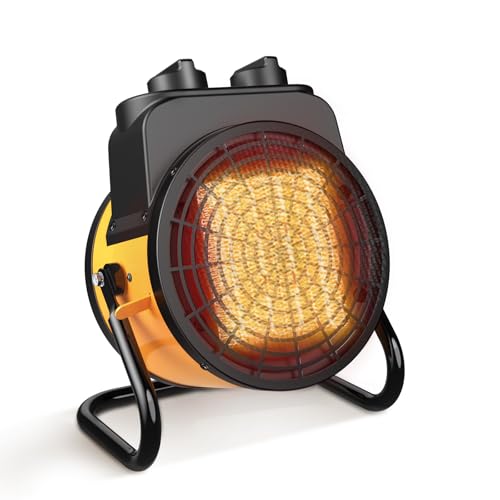
TRUSTECH’s 1500W greenhouse heater is designed for outdoor and semi-outdoor spaces like greenhouses and workshop areas. It features three heat modes and a rapid heat response, enabling quick warmth even in frigid well environments. The ETL certification underscores a focus on safety, with a thermostat that maintains consistent temperatures and prevents overheating. A 90-degree tilt capability focuses heat where it is most needed, while the compact form makes it suitable for tight utility spaces that still require reliable warmth. Its robust design supports continuous operation in environments prone to cold and damp conditions.
Considerations include heat mode versatility and the tilt feature for directing warmth, which is helpful when equipment or pipes are located in particular zones. Compliance and safety certifications add confidence for installations in facilities that require documented safety standards. For well houses that double as mechanical work areas, this model offers dependable warmth with adaptable heat delivery.
BEYOND HEAT Milkhouse Heater

BEYOND HEAT Milkhouse Heater delivers flexibility with three heat settings, including a fan-only mode, and a temperature range that supports consistent comfort in utility spaces. The unit employs a thermally regulated thermostat and offers anti-overheat and tip-over protection as safety features. ETL certification reinforces compliance with safety standards for indoor use, making it a credible option for garages, workshops, and well houses that require quiet operation and reliable warmth without excessive noise. The durable build complements environments where equipment and piping need steady temperatures to prevent freezing and condensation-related issues.
When evaluating BEYOND HEAT, consider the space size and the need for quiet operation, as well as safety features that reduce risk in cargo areas or storage spaces. The 1300-1500W range provides significant warmth for moderately sized rooms, while the thermostat lets users tailor heat output to the environment and occupancy cycles.
Buying Guide: Key Purchase Considerations For Well House Heaters
- Heat output and space sizing: Match wattage to the size of the well house, pipe proximity, and the climate. Smaller spaces may be adequately heated by 500-600W units, while larger pump houses may require 1000-1500W models or multiple units.
- Thermostat and control: Look for built-in thermostats or external controls that allow stable temperatures with minimal manual adjustments. Tamper-proof options help maintain settings in unattended spaces.
- Safety features: Essential features include overheat protection, tip-over shutoff, and ETL or equivalent safety certification. Consider models with automatic shutoff if the unit tips or if temperatures exceed safe limits.
- Durability and installation: Galvanized steel, sealed housings, and corrosion resistance extend life in damp or dusty pump houses. Consider placement, clearance, and any ventilation requirements to prevent heat buildup or fire risk.
- Convection vs. direct heating: Convection heaters distribute warmth more evenly in enclosed spaces, while direct heaters may provide rapid localized warmth. For long-term freeze protection, a convection approach often offers steadier temperatures.
- Portability and accessibility: If the space zoning changes seasonally, portable heaters with handles and manageable weight simplify relocation. In permanent installations, wall-mount or floor-mounted options reduce clutter and enhance safety.
- Energy efficiency and runtime: Evaluate the balance between constant operation versus intermittent heating. Look for models with thermostatic control and setback modes to reduce energy use while maintaining protection.
- Maintenance requirements: Choose units with simple, low-maintenance designs and few moving parts. A heater with minimal service needs improves reliability in remote well houses.
- Standards and certifications: ETL, UL, or equivalent certifications provide assurance of compliance with safety standards for electrical appliances used in utility spaces.
- Compatibility with existing infrastructure: Confirm voltage (120V in these units), plug type, and control compatibility with any smart home or monitoring systems you already use.
Selecting the right well house heater involves balancing heat output, safety, and installation practicality. The models listed here offer varied approaches—from compact 500W units designed for small pump houses to higher-capacity 1500W heaters suitable for larger spaces or more demanding freeze protection. Assess space dimensions, climate severity, and whether you prefer built-in thermostats or external temperature control to guide your choice. In environments where freezing can disrupt pumps and pipes, reliable heat delivery and durable construction are the top priorities.