Choosing the right commercial extractor fan is essential for maintaining safe, comfortable, and compliant kitchens. This guide highlights five high-performance options designed for restaurant and food-truck environments, comparing airflow, motor power, and installation considerations to help operators select the best fit for their needs.
| Product | Brand | CFM | Motor | |
|---|---|---|---|---|
| Restaurant Canopy Hood Exhaust Fan (800 CFM) | FICBXRA | 800 | 1/6 HP | Compact, suitable for smaller kitchens |
| Upblast Exhaust Fan (1500-2200 CFM) | CAPTIVE-AIRE | 1500-2200 | 0.75 HP | High-speed with included roof curb components |
| Low Profile Food Truck Exhaust (1900-2600 CFM) | FICBXRA | 1900-2600 | 0.5 HP | Low profile for vehicle mounting |
| High-Volume Exhaust Fan (3500 CFM) | FICBXRA | 3500 | 1 HP | Rugged aluminum, roof or wall mounted |
| Food Truck Exhaust (1900-2600 CFM) | HYITCL | 1900-2600 | 0.5 HP | Corrosion-resistant, easy to clean |
Note: Each product is rated for restaurant grease and general ventilation tasks and includes components to support safe operation in busy commercial environments.
FICBXRA 800 CFM Canopy Hood Exhaust Fan
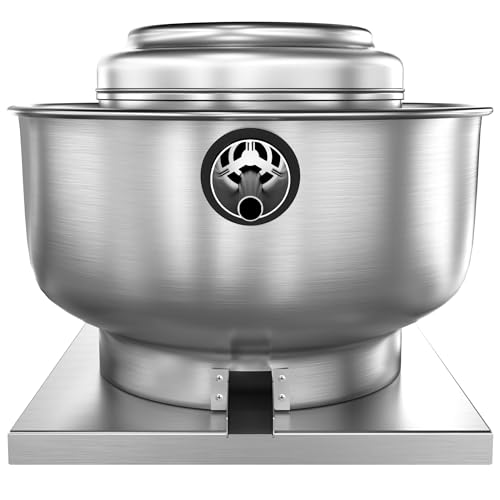
High speed direct-drive centrifugal upblast exhaust fan designed for restaurant grease and general ventilation. This unit delivers up to 800 CFM and is powered by a 110V single-phase motor (1/6 HP). It carries ETL certification, reflecting adherence to safety standards for commercial kitchen use. The compact footprint makes it suitable for smaller kitchens or spaces with roof-mounted ducting. Installation considerations include proper roof clearance and secure mounting to resist wind loads typical in urban settings.
CAPTIVE-AIRE High-Speed Exhaust Fan (1500-2200 CFM)
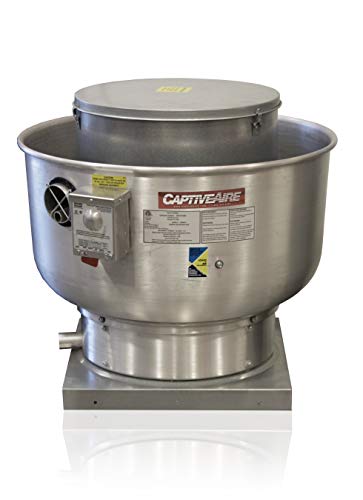
This high-speed direct-drive centrifugal upblast exhaust fan includes speed control and a 115V single-phase motor (0.75 HP). The 24 3/4″ wheel and base size provide robust airflow from 1500 to 2200 CFM, enabling flexibility for mid-sized restaurant kitchens. UL705 and UL762 listings, plus ULC-S645 rating, support compliance. The package often includes a grease cup, down spout, and hinge kit for roof curbs, simplifying installation. Consider pairing with a matching canopy hood to optimize grease capture and duct efficiency.
FICBXRA Low Profile Exhaust Fan (1900-2600 CFM)

Low-profile, high-speed direct-drive centrifugal upblast exhaust fan designed for restaurant grease and general ventilation. It operates at 110V, delivering 1900-2600 CFM with a 0.5 HP motor. UL705 and ETL rated indicate compliance with electrical and safety standards. Its compact, lightweight aluminum construction reduces weight on roofs and walls, while corrosion resistance supports longevity in greasy kitchen environments. This model suits mobile food operations or locations with limited vertical space.
FICBXRA 3500 CFM High-Volume Exhaust Fan

Large-capacity, 3500 CFM, 1 HP 110V single-phase motor exhaust fan designed for demanding kitchens. Roof or wall mounting compatible with aluminum construction touted as lightweight and corrosion-resistant. This unit is intended for high-heat, grease-heavy environments where maximum air change is necessary to maintain safe temperatures and odor control in busy restaurant settings. Consider duct sizing and make-up air requirements for optimal performance.
FICBXRA Canopy Hood Exhaust (1900-2600 CFM) For Food Trucks
High-speed direct-drive centrifugal upblast exhaust fan rated for restaurant grease and general ventilation applications. The 1900-2600 CFM range with a 0.5 HP motor makes this unit well-suited for food trucks, where space is limited yet powerful exhaust is needed. UL705 and ETL ratings ensure safety and performance in mobile kitchen environments. Installation considerations include securing the unit to the vehicle body and ensuring proper sealing to prevent air leaks.
CAPTIVE-AIRE 100-500 CFM Small Canopy Exhaust
Smaller-scale option designed for limited canopy spaces in compact kitchens. With a 19″ base and 0.180 HP motor, this unit provides between 100 and 500 CFM, making it suitable for prep areas or auxiliary ventilation. UL705, UL762, and ULC-S645 compatibility help ensure compliance with commercial kitchen ventilation standards. It can be paired with a compact hood and appropriate ducting for efficient grease management.
Buying Guide: Key Purchase Considerations
- Airflow requirements (CFM): Choose units that meet or exceed the kitchen’s clean air needs, accounting for hood area, cooking equipment, and space volume.
- Motor power and efficiency: Higher horsepower motors deliver greater airflow but may increase energy use and noise. Consider energy-efficient models with appropriate sound ratings for staff comfort.
- Ventilation type: Upblast centrifugal fans are common for grease-heavy kitchens. Evaluate whether a direct-drive design aligns with space, maintenance, and reliability goals.
- Attestation and certification: Look for ETL, UL, and UL/ULC ratings to ensure electrical safety and compliance with local codes and insurance requirements.
- Size and mounting: Base dimensions and overall footprint influence roof or wall mounting choices. Low-profile models suit restricted vertical spaces; larger fixtures suit high-traffic kitchens.
- Grease management: Features such as grease cups, down spouts, and hinge kits can simplify maintenance and reduce downtime.
- Durability and materials: Aluminum construction offers corrosion resistance in greasy environments; coatings and seals impact longevity in outdoor or coastal locations.
- Installation considerations: Roof curb compatibility, duct routing, and make-up air requirements affect overall system performance and code compliance.
- Service and support: Availability of spare parts, warranties, and local service providers influences long-term operation costs.
- Mobile vs. stationary: Mobile food operations may require low-profile or compact units with simplified mounting, while brick-and-mortar restaurants prioritize larger CFM ranges and robust canopies.