Choosing a reliable dehumidifier that pairs well with an air compressor environment helps protect equipment, prevent rust, and maintain optimal humidity levels in workspaces. This guide highlights five top-rated dehumidifiers and related air-conditioning components that commonly support compressor setups, basing selections on energy efficiency, capacity, and ease of use. Each section provides a quick product snapshot, practical use notes, and key features to consider for a compressor-centered environment.
Summary of Selected Products
| Product | Brand | Capacity / Focus | Key Benefit |
|---|---|---|---|
| AEOCKY 4500 Sq.Ft Max 80 Pint Dehumidifier | AEOCKY | 80 Pint/Day (Mid-Summer) • 56 Pint/Day Basement | Energy Star 2025 efficiency; strong basement/dry space performance |
| KeepGlad 5500 Sq.Ft Dehumidifier | KeepGlad | 98 Pint/Day | High capacity, smart controls, ultra-quiet operation |
| AEOCKY 4500 Sq.Ft Max 74 Pint Dehumidifier (2025) | AEOCKY | 74 Pint/Day | Efficient cooling and humidity control with advanced compressor tech |
| CJGHJNFF 3HP Dehumidifier Compressor Overload Protector | CJGHJNFF | Compressor protection accessory | Protects higher-capacity compressors in tough environments |
| DEWALT Inline Desiccant Dryer for Compressed Air | DEWALT | 3/8″ NPT inline dryer for air systems | Moisture removal in compressed-air lines; viewing window for desiccant |
Note: The list emphasizes dehumidification and moisture control in spaces commonly used with air compressors, as well as accessories that help protect compressed-air systems themselves.
AEOCKY Max 80 Pint Dehumidifier (Energy Star 2025)

The AEOCKY 4500 Sq.Ft Max 80 Pint/D dehumidifier targets large spaces, making it suitable for basements or workshop areas with air compressors. It is positioned as a high-efficiency model for 2025, with a 56 pint/day rating in basements under typical damp conditions. The unit emphasizes energy savings and environmental protection, noting a “Most Efficient Energy Star 2025” designation. The internal design uses a robust refrigeration system and copper components to improve heat exchange and efficiency. This model also markets as a long-term cost saver when operated 24/7 in humid climates.
Key considerations for compressor-related spaces:
- High daily dehumidification capacity helps protect metal components from rust and corrosion near compressors.
- Energy efficiency reduces ongoing electricity costs in workshop environments.
- Drain hose compatibility supports continuous drainage, which is helpful if the unit runs overnight or in poorly ventilated areas.
KeepGlad 98 Pint/D Dehumidifier for Large Spaces
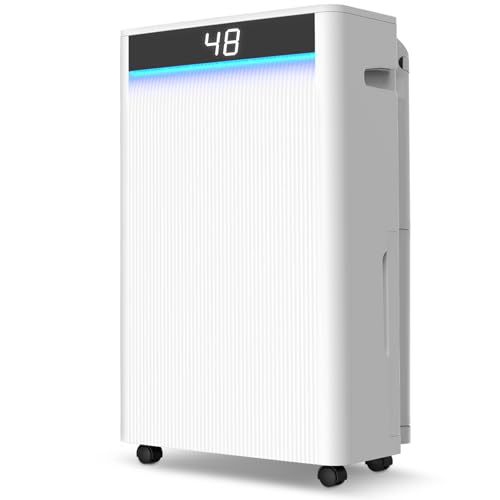
KeepGlad’s dehumidifier is designed for larger areas, capable of removing up to 98 pints per day in peak humidity conditions. This makes it a strong option for garages, basements, or workspaces that house air compressors and related equipment. It features a smart touch panel for humidity targeting and real-time monitoring, as well as automatic defrost and auto-restart after power interruption for uninterrupted operation. The model provides two drainage modes, including a large water tank with automatic shutoff and a drain hose for continuous operation.
Key considerations for compressor environments:
- High capacity helps maintain stable humidity around sensitive tools and metal components.
- Quiet operation supports a comfortable workshop environment.
- Multiple drainage options ensure reliable moisture control even during extended use.
AEOCKY 74 Pint Dehumidifier (2025)

This older but still capable AEOCKY model targets similar spaces as the 80-pint version, offering 74 pints per day in peak humidity and 52 pints per day in humid basements. It’s positioned as an efficient option that balances performance with energy-conscious operation. The design emphasizes a robust copper-based heat exchange system and a “3+2” structure in the core components for enhanced efficiency, which can be beneficial in environments near compressors where moisture is a recurring concern.
Key considerations for compressor rooms:
- Balanced capacity suitable for mid-to-large rooms with equipment heat load.
- Energy efficiency messaging may help reduce long-term operating costs with continuous use.
- Compatibility with drain hoses simplifies setup for machine rooms or basements.
CJGHJNFF 3HP Dehumidifier Compressor Overload Protector

This product is a protective accessory designed to safeguard high-capacity compressor systems. It emphasizes universal compatibility and the ability to handle overload scenarios in powered dehumidification setups that accompany air compressors. While not a standalone dehumidifier, its inclusion is relevant for workshop environments that rely on robust compressor operation alongside moisture control equipment. The accessory focuses on reliability under high load and thermal stress.
Key considerations for use with compressors:
- Provides a safeguard against compressor overload, reducing downtime risk.
- Complements dehumidification equipment in multi-machine workspaces.
- Best used with properly sized dehumidifiers in high-humidity zones around compressors.
DEWALT 3/8″ NPT Inline Desiccant Dryer

Designed for compressed-air systems, the DEWALT inline desiccant dryer uses a 3/8″ NPT connection and features clear Windows to monitor desiccant life. This unit is ideal for preventing moisture carryover in air lines and protecting tools and painted surfaces from humidity-related issues. It operates at up to 175 psi and withstands temperatures up to 140 degrees Fahrenheit, making it suitable for varied workshop conditions where air compressors are active.
Why it matters near compressors:
- Direct moisture removal from the air supply helps protect downstream tools and equipment.
- Clear window shows desiccant status for maintenance planning.
- High-pressure tolerance aligns with many workshop setups where compressors are in use.
Buying Guide: Key Purchase Considerations
When selecting a dehumidifier or moisture-control accessory for spaces with air compressors, consider the following factors to balance performance, cost, and reliability.
- Space size and humidity level: Choose a capacity that fits the room volume and typical humidity. Larger basements or garages with frequent moisture require higher pint-per-day ratings.
- Energy efficiency: Energy Star ratings and efficient refrigerant systems reduce operating costs in spaces that run continuously or for long durations.
- Drainage options: Continuous drain hoses simplify maintenance in workshop areas; non-drain units need regular tank emptying.
- Noise and vibration: In quiet or shared spaces, opt for models with low decibel ratings to minimize disruption around critical work tasks.
- Durability and build quality: Copper heat exchangers and robust components enhance longevity in environments with heat from compressors and occasional dust exposure.
- Moisture protection for tools: Moisture control improves protection for tools and metal surfaces prone to rust in compressor rooms.
- Maintenance needs: Desiccant dryers require periodic desiccant replacement, while refrigerant units need filter changes and coil cleaning.
- Integration with existing systems: Consider compatibility with existing drainage, power supply, and any protective devices (like overload protectors) for a cohesive moisture-management setup.
- Cost of ownership: Evaluate upfront price alongside expected energy savings and maintenance costs over the unit’s life.