Flood damage creates lingering humidity, musty odors, and potential mold growth. Effective dehumidification helps dry out spaces quickly, protect structural materials, and restore safe indoor air quality. Below is a curated guide highlighting five high-capacity dehumidifiers that excel in flood-recovery scenarios, with a quick reference table and practical buying tips.
Summary of Chosen Products
- Aiusevo 1500 Sq. Ft Dehumidifier — 21 pints/day, three modes, drain hose option
- AEOCKY 80 Pint Dehumidifier — Energy Star 2025 rated, suitable for large homes
- Moiswell 305 Pint Commercial Dehumidifier — industrial-grade, large spaces
- KeepGlad 98 Pint Dehumidifier — smart controls, two drainage options
- Dreo 110-Pint Smart Dehumidifier — strong performance for big areas with drain hose
Aiusevo 1500 Sq. Ft Dehumidifier

The Aiusevo dehumidifier targets spaces up to 1,500 square feet and is engineered for high moisture removal—up to 21 pints per day under hot, humid conditions (95°F, 90% RH). It supports three modes: DEHU, DRY, and CONT, allowing tailored humidity control. The DEHU mode covers a wide humidity range (30%–80%) and offers adjustable fan speeds for customized comfort. DRY mode is useful for quick moisture reduction in laundry areas, while CONT provides nonstop operation for severely damp spaces. A drain hose option enables continuous drainage for flood restoration workflows.
Key considerations include its dual drainage approach: a tank auto-shutoff when full and a 3.28-foot drain hose for continuous drainage. This is particularly helpful during flood cleanups where uninterrupted dehumidification is needed. In practice, maintaining indoor humidity around 30–50% is beneficial for preventing mold and reducing odor after water events. The compact form and straightforward controls support rapid setup in basements, bathrooms, bedrooms, or RVs that have experienced water intrusion.
AEOCKY Max 80 Pint Dehumidifier

The AEOCKY unit is positioned for larger spaces, with a daily dehumidification capacity rated at 80 pints (rates vary by conditions). It’s designed to meet or exceed contemporary energy standards (Energy Star 2025) and emphasizes efficiency in spaces over 4,500 square feet. It also notes a higher efficiency rotor compressor and a robust refrigerant circuit designed to sustain performance through extended runs—an important feature during flood-drying cycles where continuous operation is common.
For flood-damage scenarios, the model’s emphasis on energy savings translates into lower operating costs during long drying periods. A configurable humidistat and programmable drainage options (including a drain hose) help maintain consistent humidity targets. Potential considerations include ensuring sufficient airflow across damp zones and accounting for any required maintenance after period of heavy use in humid environments.
Moiswell 305 Pint Commercial Dehumidifier

Designed for heavy-duty flood remediation and large-scale drying, Moiswell offers a remarkable 305 pints per day dehumidification capacity, with 130 pints per day at AHAM. This unit is suitable for industrial spaces, warehouses, or expansive basements where rapid humidity reduction is critical. Its R32 refrigerant system emphasizes environmental responsibility with lower GWP than traditional refrigerants, while delivering strong drying performance. An impressive airflow of 412 CFM supports faster evaporation across large footprints.
While highly effective, such capacity is best matched to spaces where professional-grade moisture removal is necessary to meet remediation timelines. The unit’s robust design supports continuous operation for flood restoration tasks and works well in combination with industrial air movers or drying blankets. As with all high-capacity units, consider adequate electrical supply, appropriate drainage setup, and noise management in occupied areas.
KeepGlad 98 Pint Dehumidifier
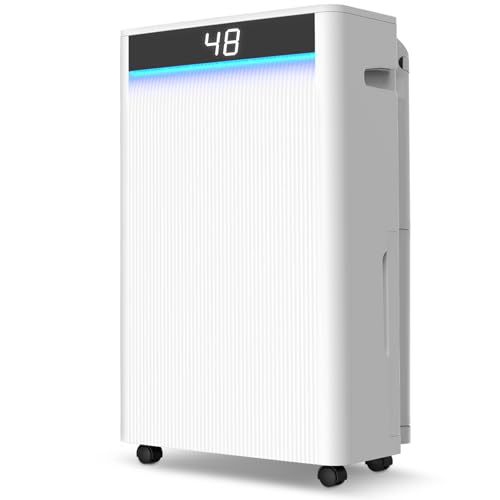
KeepGlad combines high capacity with smart features suited for flood-damage cleanup. It removes up to 98 pints per day, supporting large spaces such as basements and entire floors. A smart touch panel enables precise humidity targeting and real-time monitoring. Automatic defrost and automatic restart after power outages add reliability during storm-season moisture spikes. The unit includes two drainage options: a manual tank with auto-shutoff and a continuous-drain hose for non-stop operation.
Quiet operation (a practical benefit in living spaces) and a humidity-compensation algorithm help maintain stable conditions, reducing the risk of secondary moisture problems. For flood recovery, the dual drainage options allow flexible setup around water intrusion areas, while the timer function enables scheduled runs to fit into remediation workflows. Always ensure doors and windows remain closed to optimize dehumidification efficiency.
Dreo 110-Pint Smart Dehumidifier

The Dreo 110-Pint model targets large spaces up to 4,500 square feet and features three modes (Comfort, Auto, and Continuous) along with a 2-gallon water tank and optional drain hose for continuous removal. It emphasizes energy efficiency with a high removal rate that supports rapid humidity reduction in flood scenarios. A built-in precision humidity sensor helps maintain target RH with automatic speed adjustment, reducing overshoot and unnecessary cycling.
When used in flood-damage contexts, the ability to drain via hose is advantageous for lengthy drying sessions. The unit’s Auto mode helps maintain comfort without constant monitoring, while Continuous mode provides steady operation during ongoing moisture release from affected structures. Consider placement to ensure efficient air distribution and check hose routing to avoid kinks or leaks during operation.
Buying Guide: Key Considerations For Flood-Damage Drying
- Capacity versus space: Higher pint-per-day ratings are essential for rapid moisture removal, especially in basements or large rooms. Match the unit to the square footage and expected humidity levels.
- Drainage options: A continuous-drain hose reduces manual emptying during long remediation projects. Units with auto-shutoff when the tank fills can prevent overflow but may interrupt operation if not paired with a hose.
- Energy efficiency: In flood restoration, drying can take days. Energy-efficient models lower operating costs and support longer runtimes without excessive power use.
- Smart controls: Humidity targeting, timers, and auto restart improve workflow efficiency and consistency across multiple spaces or during night-shift drying.
- Noise and placement: Large-drum or high-capacity units can be noisy. Consider placement away from living areas or in a well-ventilated room to optimize performance and comfort.
- Maintenance and durability: Corrosion-resistant components and reliable defrost features help when using dehumidifiers in damp, mold-prone environments.
- Environmental impact: Refrigerants and GWP (global warming potential) vary by model. R32 systems often offer lower environmental impact while maintaining performance.
Selecting the right dehumidifier for flood-damage scenarios involves balancing room size, expected humidity, drainage capabilities, and energy considerations. The five products above provide a spectrum of capacities and features to match different remediation needs—from single-room basements to large-industrial spaces. Always pair dehumidification with adequate airflow, use moisture meters to track progress, and follow safety guidelines for water-damage restoration.