Basement bathrooms pose unique ventilation challenges: lower ceilings, tighter spaces, and higher humidity from damp surroundings. A reliable exhaust fan helps control moisture, reduce odors, and prevent mold growth without creating a cacophony. This guide highlights five top-rated options, based on airflow, noise levels, installation ease, and smart features. Each product is suited for smaller to mid-sized bathrooms or basement bathrooms that require steady, quiet operation and straightforward retrofits.
Summary at a glance: the following products are highlighted for basement or compact bath ventilation. They offer a range of airflow (CFM) and noise (sones) levels, with some models adding features such as humidity sensing, built-in lighting, or smart controls to optimize performance. Consider room size, duct layout, and whether you need lighting or humidity-aware operation when selecting a model.
| Product | Brand | Airflow (CFM) | Noise (Sones) | Ready for Basement Install? |
|---|---|---|---|---|
| Broan-NuTone Bathroom Exhaust Fan, 50 CFM Modern Grille | Broan-NuTone | 50 | 2.0 | Yes |
| Fanspex Bathroom Ceiling Exhaust Fan, 110 CFM | Fanspex | 110 | 1.0 | Yes |
| Broan-NuTone Bathroom Exhaust Fan With Light, 80 CFM | Broan-NuTone | 80 | 1.5 | Yes |
| ARSFAN 3 Speed With Humidity Sensor, 85 CFM | ARSFAN | 85 | 24-35 | Yes |
| Amico Bathroom Exhaust Fan, 80 CFM | Amico | 80 | 1.0 | Yes |
Broan-NuTone 50 CFM Modern Grille Exhaust Fan

Engineered for compact spaces, this 50 CFM unit is ideal for smaller basement bathrooms up to about 45 square feet. It operates at a quiet 2.0 sones, striking a balance between effective moisture removal and minimal disruption. The model features Energy Star certification for efficiency and a compact housing with foldable mounting brackets that simplify installation without attic access. Duct compatibility and overall dimensions are designed to fit tight ceiling cavities often found in basements.
Fanspex 110 CFM Quiet Ceiling Exhaust Fan

This Fanspex model delivers robust airflow suitable for medium-sized basement bathrooms, with 110 CFM that effectively moves humid air and odors. Notably quiet at 1.0 sone, it provides comfortable operation while maintaining strong ventilation. Potential buyers should verify housing size (approximately 9.1 x 9.1 inches) to ensure a proper fit in existing ceilings. Its versatile performance makes it a strong option for basements needing reliable air exchange without excessive noise.
Broan-NuTone 80 CFM Exhaust Fan With Light

This unit combines ventilation with an integrated LED light, offering 80 CFM of airflow and a quiet 1.5-sone operation. The built-in LED lighting provides lasting illumination for dim basement bathrooms, with a color temperature around 3500K. Installation is designed to be quick—no cut-roomside access needed in retrofit scenarios, which simplifies upgrading from older fans in spaces lacking attic access. The housing and cover dimensions are sized to fit common ceiling openings, reducing the need for structural changes.
ARSFAN 3 Speed Humidity Sensor Exhaust Fan
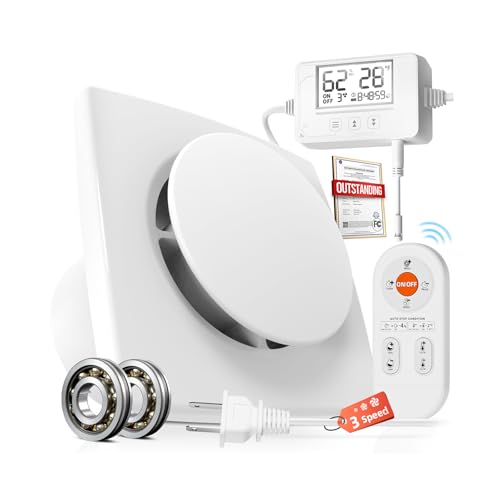
This model emphasizes humidity-driven ventilation with a smart sensor that activates automatically when moisture rises above a user-set threshold, then turns off as conditions normalize. It can operate across multiple rooms, including bathrooms and basements, offering 85 CFM with quiet performance in the 24-35 dB range. A digital display helps monitor humidity and temperature values, aiding in consistent, hands-off moisture control. Its copper motor and robust build support durable basement use.
Amico 80 CFM Ceiling Mounted Exhaust Fan

Amico’s 80 CFM model emphasizes low noise with a rated 1.0 sone operation, making it suitable for basement bathrooms where quiet performance is valued. The unit is designed for ceiling mounting with retrofit compatibility, and it comes with an appropriate duct diameter for flexible installation. Dimensions position it toward standard retrofits, minimizing demolition while delivering effective humidity management and steam removal for bathrooms up to around 80 square feet.
Buying Guide: Key Purchase Considerations
When selecting an exhaust fan for a basement bathroom, consider these factors to align with room size, ductwork, and user preferences:
- Airflow Needs: Measure the bathroom size and target 1 CFM per square foot as a baseline; smaller baths can be effectively served by 50–80 CFM, while larger basement baths or higher humidity spaces may benefit from 85–110 CFM.
- Noise Levels: Lower sones mean less audible disruption. For shared spaces or bedrooms above the bathroom, aim for 1.0–1.5 sones if possible.
- Humidity Sensitivity: If moisture is a primary concern, humidity-sensing fans automatically adapt to conditions, reducing energy use while maintaining comfort.
- Lighting Options: Integrated LED lighting can simplify upgrades, particularly in dim basement areas where additional illumination is desirable.
- Installation Ease: Look for models with easy retrofit features, compact housings, and minimal attic access requirements to simplify basement installations.
- Duct Compatibility: Verify duct size and length, rough-in dimensions, and mounting clearances to ensure fit with existing ceiling cavities and duct runs.
- Energy Efficiency: Energy Star-rated models reduce running costs and typically meet strict efficiency standards, which is beneficial for basements with continuous use.
- Durability and Materials: Basements can be harsher environments; corrosion-resistant housings and motors with good bearing designs extend service life.
- Smart and Sensor Options: Humidity sensors, timers, and remote controls can add convenience and precision in moisture-prone basement spaces.
Choosing the right model involves balancing airflow, noise, and installation constraints. For compact basement bathrooms, models in the 50–80 CFM range with low noise are often the easiest retrofit. If basement humidity is a frequent issue or you require built-in lighting, the 80 CFM LED option provides the dual benefit of lighting and ventilation. For larger basement baths or rooms prone to humidity, a higher airflow model with humidity sensing offers hands-off, adaptive control.