Choosing the right fume hood or laminar flow hood is essential for safe, compliant lab work—from chemical ventilation to sterile mycology tasks. This article highlights five practical options that balance air flow, filtration, visibility, and durability. Each product is evaluated on build quality, airflow performance, ease of use, and applicable environments to help researchers, hobbyist mycologists, and facility managers make informed decisions.
| Product | Type | Key Benefit |
|---|---|---|
| Bella Bora Still Air Box | Still air box | Enhanced visibility and durability for mycology work |
| Sentry Air Systems Fume Hood (18") | Exhaust hood | External ducting for chemical fumes with LED lighting |
| Sentry Air Systems Fume Hood (40") | Exhaust hood | Wider opening for larger workflows and rapid air exchange |
| Laminar Flow Hood (Shroomagic) | Laminar flow hood | HEPA-filtered ISO Class 5 work area for sterile tasks |
| Maisutseb Fume Hood | PP material centrifugal hood | Three-speed operation with corrosion-resistant shell |
Bella Bora Still Air Box For Mycology
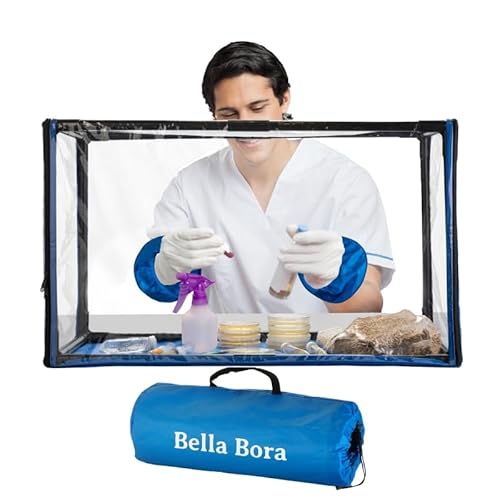
The Bella Bora Still Air Box is designed for mycology and related hydroponic tasks where a transparent enclosure and low contamination risk matter. The design emphasizes improved visibility, durable construction, and arm flexibility. It is scratch-resistant and waterproof, giving researchers a reliable workspace that reduces handling risks when working with sharp instruments. Its updated form reportedly supports longer product life and easier setup, making it a practical alternative to traditional laminar flow gear for inoculation, plating, and tissue culture demonstrations. The box accommodates disposable gloves between experiments, helping maintain a clean work environment.
Features center on precision movement and clean operation: the box promotes a snug seal around access ports while allowing users to manipulate petri dishes, spore syringes, and agar plates with minimal glove interference. The design aims to minimize cross-contamination and maximize ease of use for hobbyists and professionals alike. While not a full laminar flow cabinet, it serves as a controlled environment for several stages of mushroom cultivation and related lab work.
18" Wide Ducted Fume Hood

This 18″ wide ducted fume hood focuses on removing chemical fumes through external ductwork, with a 4″ exhaust collar for robust ventilation. It includes an LED light to illuminate work areas and supports safer handling of volatile substances. It is designed for external duct connections and requires a separate fan system for effective exhaust. The larger supply area improves air exchange for mid-sized lab tasks, making it suitable for pharmaceutical prep, chemical handling, and other environments where fumes must be controlled with a dedicated ducted system.
40" Wide Ducted Fume Hood

The 40″ wide ducted fume hood expands the work opening to support larger experiments or multiple prep stations. It features a 6″ exhaust collar and built-in LED lighting for clear visibility during procedural steps. Note that vinyl curtains are shown in promotional images but are not included by default. This model relies on external ductwork and a fan system for fume removal, offering a scalable solution for busy labs that require higher air exchange rates and more generous workspace for chemical handling or process development.
Laminar Flow Hood With H13 HEPA Filter

The Laminar Flow Hood from Shroomagic provides a sterile work environment with an H13 HEPA filter, designed for ISO Class 5 cleanliness. The cabinet measures 20 by 16.8 by 7.9 inches of overall space, with a 20 by 15 inch working area. Dual DC brushless fans and an internal LED light support stable laminar flow at velocities around 0.35–0.5 m/s and up to 249 CFM. This configuration is well-suited for mycology, tissue culture, and cleanroom tasks that demand high particle control. The unit’s compact footprint makes it a practical choice for bench-top use in small labs or hobby spaces.
Maisutseb Fume Hood Blowers

The Maisutseb fume hood blends a robust PP shell with a copper-core motor for corrosion resistance and high heat tolerance. It provides three-speed operation to adapt to different lab tasks, from high-velocity exhaust during aggressive chemical processes to quieter levels for delicate experiments. The unit emphasizes electrical safety and continuous operation, with protective features to prevent overheating. This option is ideal for environments where harsh solvents or frequent use require resilient construction and flexible airflow management.
Buying Guide: Key Purchase Considerations
When selecting a fume hood or laminar flow hood, consider the following factors to align with your lab’s needs:
- Purpose and environment: Choose based on whether you need chemical fume removal (ducted hoods) or sterile airflow (laminar flow/HEPA-filtered units) for mycology, cultures, or tissue work.
- Airflow and filtration: Look for specified airflow rates (CFM) and filtration standards (H13/H14 HEPA). Higher CFM aids rapid exchange; HEPA filters ensure 99.95–99.995% removal of fine particles.
- Size and footprint: Benchtop models save space; larger hoods accommodate bigger workspaces but require more room and ducting capabilities.
- Material and durability: PP shells and copper motors offer corrosion resistance and longevity in challenging chemical environments; consider scratch-resistant, waterproof surfaces for longevity.
- Versatility and accessories: Some units double as glove-box alternatives or provide integrated lighting. Confirm included components (curtains, gloves, or ports) and compatibility with disposable gloves or external ducts.
- Maintenance and safety: Evaluate ease of cleaning, accessibility of filter replacement, and electrical safety features. For ducted systems, plan for safe routing of exhaust and energy use.
- Budget and total cost of ownership: Consider initial price, ongoing filter costs, energy use, and the lifespan of the cabinet in relation to expected throughput and maintenance needs.
Comparative Overview
– For mycology and closed-system experiments, the Bella Bora Still Air Box offers visibility and ease of setup, but it is not a full enclosure with HEPA filtration.
– For chemical fume management with external ducting, Sentry Air Systems’ 18″ and 40″ models provide scalable airflow and LED illumination, suitable for laboratories with existing ductwork and fans.
– For sterile work, the Shroomagic laminar flow hood delivers ISO Class 5 cleanliness and integrated lighting, ideal for inoculation and tissue culture tasks.
– For robust, budget-friendly exhaust control, the Maisutseb hood presents a corrosion-resistant shell and three-speed options suitable for broad lab use.
Each option supports different workflows. Labs focused on mycology or plant tissue culture benefit from a transparent glove-box approach or laminar flow units with HEPA filtration. Chemical labs needing external exhaust will prefer ducted hoods with dedicated ductwork and reliable illumination. The right choice depends on your specific process, space, and safety standards.