Maintaining proper humidity in crawl spaces is essential to prevent mold growth, wood rot, and structural damage. This guide highlights five reliable humidity sensors ideal for crawl spaces, focusing on accuracy, remote monitoring options, battery life, and data logging. Each option supports consistent moisture tracking and alerts to help protect your home. Explore real-world features, setup ease, and how they fit typical crawl-space environments.
Product Summary Table
| Product | Main Focus | Remote Access |
|---|---|---|
| Govee Bluetooth Hygrometer Thermometer | Swiss-made accuracy, on-board data storage | App-based (Bluetooth, 262 ft) |
| ThermoPro TP60 Digital Hygrometer | Long-range wireless (500 ft) | App-ready with remote readings |
| SensorPush HT.w Smart Sensor | Smart, Bluetooth humidity/temperature | Bluetooth range with optional WiFi gateway |
| SensorPush HT.w (1 Pack) | Simple, reliable multi-sensor monitoring | Bluetooth with optional WiFi gateway |
| OBET Indoor Outdoor Thermometer | Multi-sensor with backlit display | Wireless remote sensing |
Govee Bluetooth Hygrometer Thermometer Overview

Govee offers real-time monitoring of temperature and humidity via a dedicated mobile app. It supports a 262-foot Bluetooth range (no obstacles) and keeps on-board data for 20 days, with export options to CSV for extended analysis. The Swiss-made sensor ensures precision, reporting temperature to ±0.54°F and humidity to ±3%RH, refreshing every 2 seconds. This setup is well-suited for crawl spaces where a battery-powered, non-WiFi option can simplify installation while still providing alerting and historical data via the app.
ThermoPro TP60 Digital Hygrometer

The ThermoPro TP60 provides a broad 500-foot range, suitable for monitoring multiple zones within a crawl space and surrounding areas. It records indoor/outdoor temperature and humidity, supports MAX/MIN readings, and offers a simple tabletop or wall-mount design. It operates on batteries included in the package and displays readings clearly, with the option to monitor via a companion app. Its long-range capability helps when crawl spaces are connected to larger home areas through walls or basement corridors.
SensorPush HT.w Smart Sensor
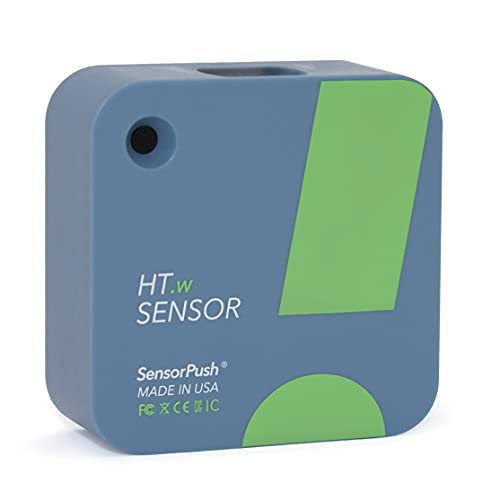
The HT.w model offers straightforward Bluetooth-based monitoring with a quick setup process. It provides 24/7 monitoring of temperature, humidity, dew point, and VPD, with 45 days of onboard data logging and unlimited in-app storage. While in-range, the app updates in near real-time, enabling rapid alerting. A G1 WiFi Gateway (sold separately) can extend remote access beyond Bluetooth range, making it suitable for crawl spaces where you want remote visibility without running cables.
SensorPush HT1 Digital Sensor

The HT1 is another compact SensorPush option featuring quick Bluetooth pairing and reliable data capture. It supports daily data logging and easy export for deeper analysis. Like the HT.w, expanding remote access with a G1 gateway enables viewing data remotely, which is valuable for crawl spaces that need continuous monitoring without manual checks.
OBET Indoor Outdoor Thermometer

OBET provides a versatile indoor-outdoor temperature and humidity monitoring solution with three sensors and a large, backlit display. It features a 500-foot range and supports multiple locations, making it useful for crawl spaces connected to other parts of the home. The device displays Min/Max values, trend data, and comfort indicators, aiding quick assessments of moisture risk in dimly lit or hard-to-reach areas.
Buying Guide: Key Considerations For Crawl Space Monitoring
When selecting a humidity sensor for crawl spaces, consider accuracy, data logging, alerting, and how you access data over time. Different environments—sealed crawl spaces, moisture-prone basements, or utility tunnels—benefit from varying connectivity and power options. Here are the main factors to weigh:
- Connectivity: Bluetooth-only devices require proximity to a phone or a gateway for remote access. If you need alerts away from home, choose models with a WiFi gateway option or long-range wireless capability.
- Accuracy and range: Look for sensors with humidity accuracy within 2-3% RH and temperature within roughly 0.5-1.0°F. An extended data range (days to years) helps track seasonal moisture patterns.
- Data logging and export: On-board storage and easy CSV export simplify long-term moisture trend analysis. Decide how many days of data you need locally and remotely.
- Power options: Battery life matters in tight crawl spaces. Some sensors use replaceable batteries; others may have USB power or long-life cells. Consider maintenance frequency.
- Alerting: Real-time notifications help prevent damage. Check whether alerts are push notifications, email, or app-based and if you can customize thresholds.
- Durability and placement: For crawl spaces, choose sensors with compact form factors and, if needed, water resistance or damp-environment tolerance to avoid false readings.
- Multi-sensor networks: In larger crawl spaces, a network of sensors provides comprehensive coverage. Check if the system easily scales with additional units.
In practice, a Bluetooth-based unit with a WiFi gateway offers a good balance between installation ease and remote access for crawl spaces with intermittent network reach. For installations spanning multiple rooms or with thick walls, consider units with extended ranges (up to 500 ft) or the ability to form a network of sensors.