If you rely on propane for RV cooking, heating, or hot water, a reliable auto changeover regulator is essential. The right regulator keeps your propane supply steady even as tanks empty or as you refill on the road. The products below are designed for dual-tank RV setups, offering automatic transfer from the primary to the reserve tank without interruption. This guide highlights five strong options, compares features, and offers practical buying tips to help you choose the best propane valve regulator for your RV lifestyle.
Summary Of Selected Products
| Product | Brand | Key Feature | BTU Capacity |
|---|---|---|---|
| Flame King KT12ACR-2 | Flame King | Two 12″ pigtails; dual-tank auto-changeover; UL regulator | 345,200 BTU |
| RecPro 2-Stage Auto Changeover | RecPro | Automatic full-tank switching; lightweight with included pigtails | 250,000 BTU |
| Fairview GR-9984 | Fairview | High flow in cold temps; auto-switching | High capacity |
| Alloxity 2-Stage Auto Changeover | Alloxity | Dual-tank with gauge and color indicators | 210,000 BTU (primary) / 130,000 BTU (reserve) |
| Samplife RV Propane Regulator 2 Tank | Samplife | Includes gauge and 18″ hoses; dual-tank auto-switch | 210,000 BTU / 130,000 BTU |
Flame King KT12ACR-2: Dual-Tank Auto Changeover
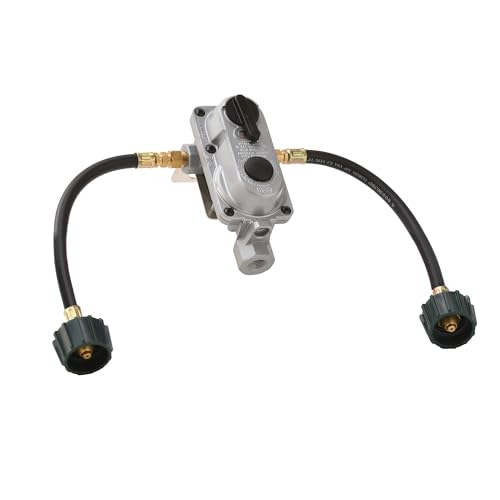
The Flame King KT12ACR-2 is a two-stage, auto changeover propane regulator designed for RVs with dual tanks. It offers two 12-inch pigtails to connect the regulator to the propane supply, enabling seamless replacement of an empty cylinder without interrupting fuel flow. The unit automatically switches from the primary to the reserve tank when the primary is empty, simplifying dual-tank operation for RVs, vans, and trailers. It uses a UL-listed regulator with 1/4″ SAE inverted flare inlets and a 3/8″ NPT female outlet, rated up to 345,200 BTU. This model is well-suited for users who need reliable dual-tank performance and straightforward installation.
RecPro 2-Stage Auto Changeover

RecPro’s 2-Stage Auto Changeover regulator simplifies propane management for RVs by automatically switching to the full tank, with a red indicator window to signal when a tank is depleted. The setup includes 11.5″ pigtail hoses and a compact design that weighs about 2.5 pounds, making installation and transport easy. The QCC1 hoses integrate a flow limiter and check valve for enhanced safety. Inlets are 1/4″ female NPT, and the outlet is 3/8″ female NPT, with a maximum working pressure of up to 250 PSI. Ideal for campers and trailers seeking reliable automation and easy setup.
Fairview GR-9984 High Capacity Regulator

The Fairview GR-9984 stands out for high capacity operation and reliable cold-weather performance. It automatically switches to the second tank when the first is empty, ensuring continuous gas supply in variable outdoor conditions. Notably, mounting screws are not included, so installation considerations should include hardware selection and compatibility with existing RV mounting solutions. This model emphasizes maximizing flow and minimizing cold-weather restrictions, making it a strong option for RVers who operate in cooler climates or require robust performance regardless of temperature.
Alloxity 2-Stage Auto Changeover With Gauge

Alloxity offers a 2-stage auto changeover regulator with dual tank support and an indicator gauge that designates the active tank. The regulator provides primary and reserve flow ratings of 210,000 BTU/hour and 130,000 BTU/hour, respectively. It uses 1/4″ SAE inverted flare inlets and a 3/8″ NPT female outlet. The included gauge and durable brass construction make this a practical choice for RVs and trailers requiring clear tank status and dependable performance in a compact package that resists outdoor wear and corrosion.
Samplife RV Propane Regulator 2 Tank Kit
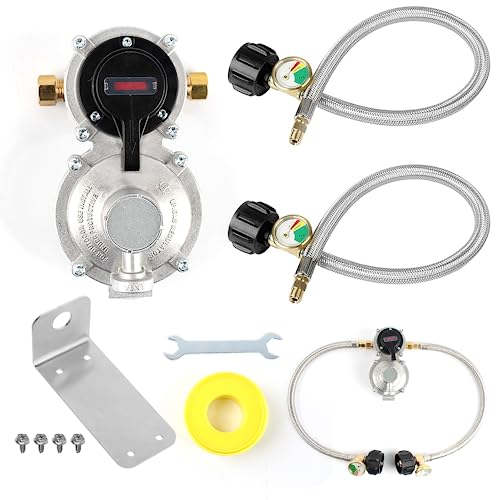
Samplife’s dual-tank regulator kit includes an auto-changeover regulator, a gauge, and two 18″ pigtail hoses. The design emphasizes user-friendly operation with a color-changing indicator to signal when a tank is depleted. The kit’s stainless steel braided hose offers weather resistance and flexibility, with 210,000 BTU/hour primary and 130,000 BTU/hour reserve capacities. Inlets are 1/4″ SAE inverted flare, and the outlet is 3/8″ NPT, making it compatible with standard RV propane systems while delivering reliable performance for camping, trailers, and mobile living spaces.
Buying Guide: Key Considerations For Selecting An RV Propane Regulator
- Tank compatibility and auto-changeover: Look for dual-tank capability with automatic transfer between primary and reserve tanks. Indicators or gauges help monitor tank status without manual checks.
- BTU capacity and pressure: Ensure the regulator supports sufficient BTU/hour for your appliances. Common ranges include 210,000–345,200 BTU, with a safe operating pressure suitable for RV use.
- Inlet/outlet sizing and fittings: Most RV regulators use 1/4″ SAE inverted flare inlets and 3/8″ NPT outlets. Confirm compatibility with your hoses, hoses’ clamps, and tanks.
- Build quality and durability: Choose brass construction for corrosion resistance and long life in outdoor conditions. UL-listed regulators offer additional safety assurance.
- Accessories and kit contents: Some models include pigtail hoses, mounting brackets, and gauge indicators. Consider whether you need these inclusions for easy installation.
- Cold weather performance: In cold climates, regulators with high-flow capabilities while maintaining gas delivery are beneficial to prevent drops in performance.
- Installation space and mounting: Check whether the regulator requires mounting hardware and whether your RV has a suitable space to secure it safely.
- Safety features: Flow limiters, check valves, and leak detection indicators enhance safety during operation and refilling.
When selecting, compare both the primary and reserve flow ratings, as well as the physical dimensions to ensure fit within your RV’s storage area. If you frequently refuel or move locations, a regulator with clear indicators and easy servicing can reduce downtime and improve reliability. Always follow manufacturer installation guidelines and replace aging components to maintain safe, consistent propane delivery for cooking, heating, and hot water on the road.