Choosing the right roof exhaust fan for a warehouse involves balancing airflow, durability, noise, and weather resistance. The following selections are among the best options available, offering high CFM, robust construction, and reliable performance in demanding environments. Each product is evaluated for suitability in large spaces, smoke and heat exhaust, and weather exposure typical of commercial facilities.
| Product | Brand | CFM | Key Benefit |
|---|---|---|---|
| ExploreHorizon 2400CFM Upblast Roof Exhaust Fan | ExploreHorizon | 2400 | High airflow with silent operation |
| FICBXRA Roof Extractor Fan 897 CFM | FICBXRA | 897 | Strong, reliable 2500 RPM performance |
| Master Flow GAF 1500 CFM Roof Mount Attic Fan | Master Flow | 1500 | Smart thermostat control and durable build |
| HYITCL Roof Mounted Downblast Exhaust Fan | HYITCL | 500 | Direct drive, weather-resistant. |
| Solar Attic Fan 1250+ CFM | Bsteciar | 1250+ | Solar-powered with AC backup for reliability |
Use this guide to compare options, check compatibility with your warehouse layout, and identify which model aligns with your maintenance and energy goals. The list below covers five products most relevant to warehouse exhaust needs, focusing on airflow, installation ease, noise levels, and weather durability.
ExploreHorizon 2400CFM Upblast Roof Exhaust Fan

- CFM: 2400, ideal for large warehouses with heat and odor control needs
- Upblast design with a 27.36″ x 27.36″ base for stability
- Upgraded motor for reliability and long-term performance
- Silent operation to minimize workplace disruption
FICBXRA Roof Extractor Fan 897 CFM
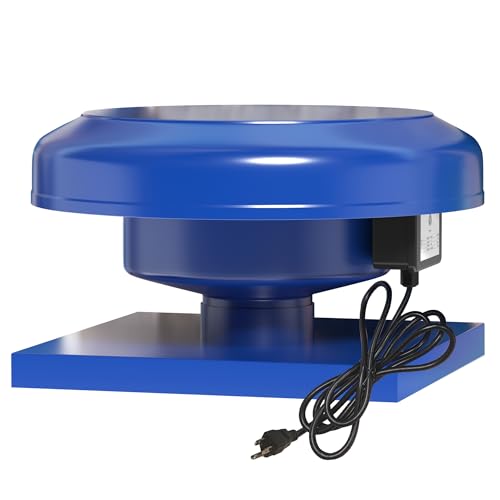
- Airflow: 897 CFM at 2500 RPM for robust ventilation
- Metal shell with corrosion-resistant finish for durability
- Low-noise operation suitable for busy facilities
- ETL Listed and built to withstand warehouse environments
Master Flow GAF 1500 CFM Roof Mount Attic Fan

- Airflow: Up to 1500 CFM for attic and warehouse spaces
- Thermostat control and humidistat options for energy efficiency
- Durable galvanized steel construction
- Built-in screen helps prevent debris entry
HYITCL Roof Mounted Downblast Exhaust Fan

- CFM: 500 with direct-drive axial design
- Spun aluminum construction for rust resistance
- Fully enclosed, permanently lubricated ball-bearing motor
- Includes built-in bird screen for discharge protection
Solar Attic Fan 1250+ CFM By Bsteciar

- Solar-powered operation with 35W panel; AC backup supports continuous use
- Airflow up to 1250+ CFM for attic and venting needs
- Smart thermostat integration and auto-start at elevated temperatures
- Weather-resistant aluminum housing and low noise (<30 dB)
Buying Guide: Key Considerations For Warehouse Roof Exhaust Fans
Airflow capacity: Large warehouses typically require higher CFM ratings to effectively remove heat, smoke, and odors. Consider space size, ceiling height, and the expected heat load when selecting a model. A higher CFM is not always better if it leads to excessive energy usage; match capacity to occupancy and equipment.
Durability and weather resistance: Roof exhaust fans face wind, rain, and temperature fluctuations. Look for galvanized or aluminum housings, corrosion-resistant finishes, and weather-sealed motors. For outdoor deployment, corrosion resistance and IP ratings are important.
Noise and vibration: Noise can impact worker comfort and safety compliance. Models with sealed bearings, quiet operation modes, and vibration-dampening mounts perform better in active warehouses. Consider installation in areas adjacent to offices or break rooms where noise sensitivity matters.
Motor type and reliability: Direct-drive motors generally offer robust performance with fewer moving parts. Evaluate motor enclosure, lubrication needs, and maintenance intervals. In dusty environments, sealed motors maximize longevity.
Energy efficiency and control: Thermostat or humidistat integration helps conserve energy by turning fans on only when needed. Some solar-powered options with AC backups provide reliable operation during power interruptions, which can be advantageous in remote facilities.
Installation and compatibility: Check mounting footprint, duct connections, and electrical requirements. Some fans are designed for upblast vs. downblast configurations; ensure the chosen model suits your roof layout and clearance.
Maintenance and serviceability: Access to replacement parts, availability of bearings, and ease of cleaning influence long-term cost of ownership. Choose models with accessible serviceable components and clear maintenance guidance.
Compliance and safety: Ensure selections meet local building codes and industry standards. ETSL or UL listings provide confidence in safety and performance for commercial use.