Product Snapshot
| Product | Brand | Airflow / Tank | Noise Level | Best For |
|---|---|---|---|---|
| Timbertech Upgraded Airbrush Single-Piston | TIMBERTECH | 20-23 L/Min, 3L | Quiet (47db) | Nails, makeup, models |
| Timbertech Airbrush Compressor AS186 | TIMBERTECH | 20-23 L/Min, 3L | Quiet (47db) | Hobby, cake, tattoos |
| Silentaire Super Silent 20-a | Silentaire Compressors | 0.7 CFM | Very low (approx. 30 dB) | Airbrush art, fine detail |
| XBBXBB Upgraded 55PSI Dual-Action Kit | XBBXBB | 55 PSI, 7-13 L/min | Ultra silent | Cake, makeup, nails, model art |
| Silentaire DR-500 Silent Running | SilentAire | 2.15 CFM | Low | Professional airbrushing |
Quiet, reliable airbrushing compressors help artists achieve crisp lines and smooth gradients without the hum of loud equipment. This guide highlights five top options that balance low noise with steady airflow, so you can work for longer sessions without distraction. Each choice is suited to different uses—from hobby projects to professional makeup and automotive graphics—while prioritizing minimal sound and low maintenance.
Timbertech Upgraded Airbrush Single-Piston Compressor
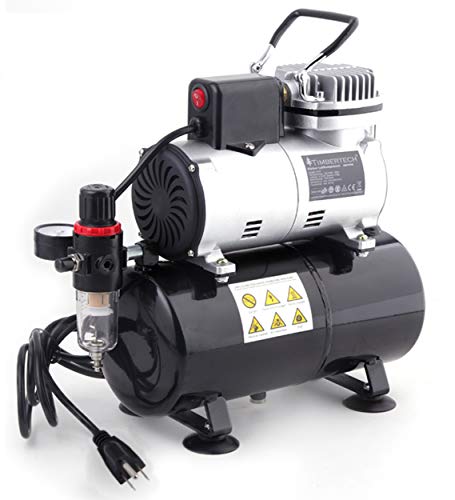
Timbertech’s upgraded single-piston unit uses an oil-free piston to reduce maintenance. A built-in cool-down fan helps manage heat, extending the life of the compressor during longer sessions. The 3-liter receiver tank stabilizes output for steady performance at 20-23 L/Min, supporting a typical airbrush with 0.2–0.8 mm nozzles. It’s compact and portable, with a carry handle for easy transport. Noise is rated around 47 dB, allowing discreet operation at home, in studios, or workshops. The moisture trap and regulator enable clean, adjustable air for precise application, from nails to automotive graphics.
Timbertech Airbrush Compressor AS186

This Timbertech model emphasizes maintenance-free oil-less operation with a compact form factor and quiet performance around 47 dB. The 3-liter receiver tank helps deliver pulse-free output with consistent air flow of roughly 20-23 L/Min, reducing interruptions between refills for longer work sessions. It features an autostart at about 3 Bar and autostop at 4 Bar, making it compatible with a wide range of airbrush units (0.2–0.8 mm nozzles, not included). A built-in carry handle adds portability for studios, classrooms, or on-site projects.
Silentaire Super Silent 20-a
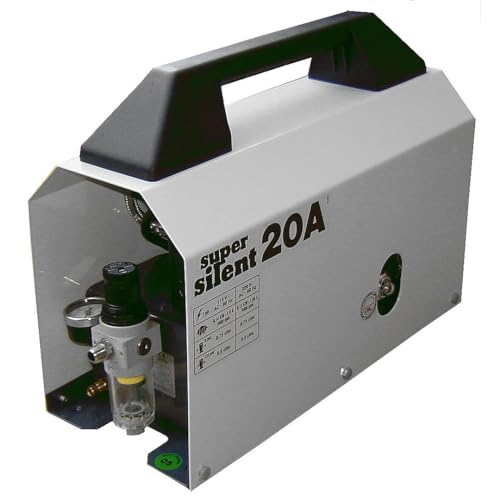
The Silentaire 20-a is designed for near-silent operation, boasting a noise level around 30 dB. It delivers 0.7 CFM with a maximum pressure of 85 PSI, which is well-suited for fine airbrushing work that requires consistent, delicate control. This makes it a strong choice for artists who need a quiet environment—ideal for indoor work, teaching settings, or homes with sensitive equipment. Its proven track record in the industry ensures reliable performance for detailed work such as cosmetic artistry and precision modeling.
XBBXBB Upgraded 55PSI Dual-Action Kit

This kit from XBBXBB delivers a robust 55 PSI via an ultra-silent design, with an airflow range of 7-13 L/min. The 7-level adjustable pressure makes it versatile for fine detail or broad coverage, and its dual-action capability supports precise control of paint flow and air. It’s suitable for cake decoration, makeup, model painting, nail art, and tattoo work. It also supports two airbrushes simultaneously, enabling collaborative projects or more complex applications. This makes it a compelling option for hobbyists and professionals seeking flexibility without sacrificing quiet operation.
Silentaire DR-500 Silent Running

The Silentaire DR-500 is designed for professional-grade silent operation, with a high-output capability that remains subdued. It emphasizes continuous performance with a generous output of 2.15 CFM and a maximum pressure of 114 PSI, with a typical operating range of 84-114 PSI. This makes it suitable for artists requiring sustained power for larger projects or heavy-duty airbrushing across multiple materials. The machine emphasizes long-term reliability and low noise, supporting demanding workloads in art studios or production environments.
Buying Guide: Key Considerations For Airbrush Compressors
- Noise Levels: If you work in a home, studio, or classroom, prioritize units advertised as “quiet” or “silent.” Look for decibel (dB) ratings around 30-50 dB for comfortable operation.
- Airflow And Tank Size: Higher CFM (or L/Min) supports faster painting and less waiting between passes. A larger receiver tank stabilizes output, reducing fluctuations during bursts of paint or color changes.
- Oil-Free Design: Oil-free pistons reduce maintenance and prevent oil contamination in paints. This is generally preferred for cosmetic, cake decor, and artwork applications.
- Autostart/Autostop Features: These help regulate pressure, conserve energy, and extend pump life by starting and stopping automatically at set pressures.
- Portability: For artists who travel or work in small spaces, a compact, lightweight unit with a carry handle increases flexibility in setup and teardown.
- Compatibility: Check nozzle size compatibility (commonly 0.2–0.8 mm) and whether the unit includes hoses, moisture traps, or regulators, as these affect your setup and cost.
- Maintenance: Oil-free systems reduce routine maintenance, but regular moisture management and filter checks remain essential to ensure consistent spray quality.
- Applications: Consider your primary use—nails, makeup, cake decoration, model painting, or automotive graphics—as different work demands vary in required PSI and airflow.
When choosing among these options, match the compressor’s specifications to your typical workflow: precision, quiet operation, and continuous air supply. For hobbyists and beginners, compact models with low noise and reliable regulators are ideal. For professional settings, higher CFM and steady output with robust build quality may be required, even if it means accepting a slightly louder unit. Always verify that the included components align with your airbrush guns and paints to ensure optimal performance.