The right temperature control system helps protect greenhouse crops from heat stress, cold snaps, and uneven heat distribution. This article compares five reliable digital controllers that are well-suited for greenhouse environments, including dual-relay units for heating and cooling, remote monitoring, and robust safety features. Each product is described with its key strengths and typical applications to help you choose the best fit for your setup.
| Product | Key Feature | Best For |
|---|---|---|
| Inkbird ITC-308 (2-Stage) | Dual relay, Celsius/Fahrenheit display | Simple heating and cooling control |
| Inkbird WiFi ITC-308 | Remote monitoring via app, dual relay | Rural or large setups needing remote access |
| WILLHI WH2408 | Wide range -58°F to 230°F, intuitive two-knob control | User-friendly, diverse greenhouse tasks |
| BN-LINK Reptile Thermostat | Easy setup, reliable LED indicators | Seedlings, heat mats, and small greenhouses |
| DEWENWILS Digital Temperature Controller | 15A/1800W, VA display, heating and cooling modes | High-power heaters and cooling devices |
| Bayite BTC211 | 15A dual relay, pre-wired, 110V-240V | Fermentation, reptile habitats, and horticulture |
Introduction continues: This guide emphasizes controllers with dual-relay capabilities, clear displays, and reliable sensors. When selecting a model for a greenhouse, consider power needs, sensor placement, alarm features, connectivity, and ease of use. The sections below detail five carefully chosen options, each with practical notes for greenhouse applications, including installation tips and maintenance reminders.
Inkbird ITC-308 Digital Temperature Controller

The Inkbird ITC-308 offers a straightforward two-stage setup that can power heating and cooling equipment as conditions change. Its dual relay design lets you run a heater and a fan or cooler simultaneously, which is ideal for maintaining stable greenhouse temperatures. The large dual display shows current and set temperatures, reducing guesswork during day-night transitions. The unit supports both Celsius and Fahrenheit displays, making it adaptable for different users. Its compact form simplifies mounting in control panels or near grow racks, while the 110V/10A rating covers many common greenhouse devices.
Key considerations for greenhouse use include sensor placement to avoid heat pockets near lights and ensuring the external power supply remains protected from moisture. Regular calibration checks help preserve accuracy across growing seasons. This model is well-suited for entry-level setups or as a reliable backup controller in larger systems, where straightforward operation and dependable dual-relay control are valued.
Inkbird WiFi ITC-308 Digital Temperature Controller

This model adds remote monitoring capabilities through WiFi and the INKBIRD app, enabling temperature control from anywhere with internet access. Dual-relay outputs accommodate independent heating and cooling equipment, which is useful when managing greenhouse climate during variable weather. Alarms for high/low temperatures help growers respond quickly to sensor faults or environmental changes. The ability to monitor and adjust settings remotely reduces on-site visits, saving time and energy. For larger greenhouses, remote access supports more proactive climate management.
When deploying, ensure stable WiFi coverage across the greenhouse space. Consider a backup timer or local display in case of connectivity loss. This unit shines for growers who want remote oversight without sacrificing the reliability of a proven two-stage controller.
WILLHI WH2408 Temperature Controller

The WILLHI WH2408 provides a broad control range suitable for greenhouse needs, with two knobs for intuitive on/off temperature adjustments. It covers a wide ambient range and supports both heating and cooling modes, making it versatile for seasonal shifts. The unit’s robust construction includes a fire-retardant housing and a probe designed for accurate ambient measurements. Its simple interface minimizes setup time and reduces the risk of misconfiguration in a busy greenhouse environment. The device memorizes settings during power outages, which reduces disruption when electricity is interrupted.
Use this controller where quick, dependable responses are needed without navigating complex menus. Pair with heaters, fans, or vents to maintain consistent conditions across zones, especially in larger greenhouses with uneven heat distribution. Always route power through a surge-protected outlet to safeguard equipment and data integrity.
BN-LINK Reptile Thermostat Temperature Controller

The BN-LINK reptile thermostat focuses on reliable, easy operation with a bright display and three-button setup. While marketed for reptile habitats, its smooth interface and LED indicators translate well to small greenhouse zones and seedling mats. The controller supports multiple heating devices and a simple sensor probe for precise temperature tracking. It’s a practical choice for growers starting out or managing compact greenhouses where straightforward control is preferable to feature-rich but complex models. The unit includes a durable power cord and a long temperature probe for flexible placement.
Consider using this model for seedling trays or small beds where you need consistent heat without overcomplication. It’s less suited for large-scale heating systems but excels in simplicity and affordability for focused climate control tasks.
DEWENWILS Digital Temperature Controller
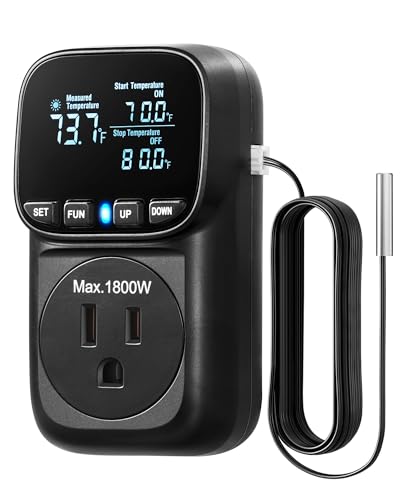
The DEWENWILS digital controller delivers high-power handling with a 15A/1800W output, making it suitable for larger heaters, fans, or dehumidifiers in a greenhouse. Its VA display provides clear visibility in dim conditions, complemented by a wide -40℉ to 210℉ temperature range and 0.1℉ precision. The dual heating and cooling modes enable flexible climate management, while the timer features support cyclic timing and countdown functions to automate daily cycles. This model is designed for heavy use and can help stabilize temperature in larger grow spaces or rooms with significant thermal inertia.
Practical considerations include ensuring adequate ventilation around the unit to prevent overheating and verifying that the connected devices are compatible with the 1800W load. Use this controller when you need robust control and visibility in a demanding greenhouse setting.
Bayite BTC211 Dual Digital Outlet Thermostat
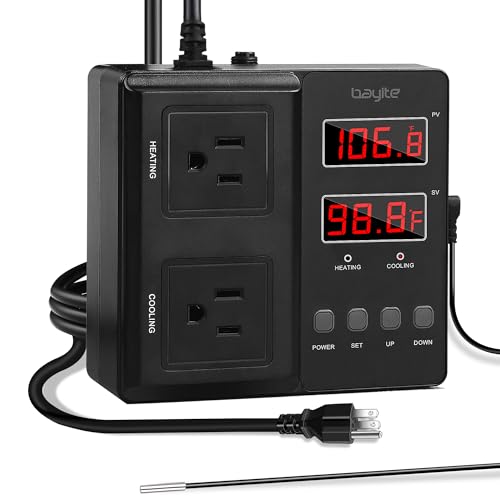
The Bayite BTC211 combines dual digital outlets with a straightforward plug-and-play experience. It supports both heating and cooling operations and displays real-time temperature alongside the setpoint. The device is rated for 110V-240V operation, enabling versatile use in different regions or setups. The pre-wired design and dual display window simplify monitoring, and the dual relays allow simultaneous control of separate devices such as a heater and vent fan. It’s well-suited for fermentation, greenhouse zones, or reptile habitats where both warmth and airflow need to be coordinated.
When implementing, ensure the sensors are placed away from direct heat sources and drafts to avoid skewed readings. Consider adding a backup temperature sensor for larger installations to maintain resilience against sensor failure.
Buying Guide: Key Purchase Considerations
- Temperature range and precision: Choose a model with a suitable range for your crops and environment. A precision of 0.1℉ or 0.1°C helps stabilize microclimates in plant beds and propagation areas.
- Relay configuration: Dual-relay units allow independent control of heating and cooling devices. This is crucial for greenhouse climates with wide diurnal variation.
- Display and readability: Large, bright displays reduce errors during setup and daily checks. VA or LCD displays are both effective, especially with clear setpoint indicators.
- Connectivity and monitoring: WiFi or app-enabled controllers enable remote monitoring and alerts, reducing on-site visits for larger or multiple-zone greenhouses.
- Sensor placement and protection: Install probes away from direct radiation and drafts; shield sensors from moisture and ensure cords are rated for outdoor or humid conditions.
- Power handling and safety: Match the controller’s maximum load rating to your equipment. Use surge protection and proper enclosure to guard against moisture and electrical faults.
- Reliability and support: Look for models with a history of durability, easy calibration, and dependable customer support or warranty.
- Energy efficiency: Controllers with accurate sensing and reliable alarms help minimize energy use by avoiding overheating and unnecessary operation.
- Maintenance considerations: Regularly check sensor integrity and recalibrate if needed, especially after long storage or transport periods.
These factors help compare models across price, power, ease of use, and feature sets. For greenhouse users, a durable dual-relay controller with remote monitoring capability often offers the best balance of control and convenience, enabling precise climate management across multiple zones or functions.