Choosing the right thermostat for heat lamps ensures stable temperatures for reptiles, seedlings, and greenhouses. This guide reviews five reliable digital controllers that help maintain consistent warmth, prevent overheating, and save energy. Each option supports common heat sources like heat lamps and mats, and many feature memory functions, easy setup, and durable construction. Read on to compare capabilities and select the best fit for your heating needs.
| Product | Brand | Temp Range | Key Use |
|---|---|---|---|
| BN-LINK Reptile Thermostat | BN-LINK | 40-108°F | Seed starting, reptile tanks, incubators |
| WILLHI WH2408 | WILLHI | -4°F to 140°F (-20°C to 60°C) | Terrariums, greenhouses, brewing |
| Inkbird ITC-308 | Inkbird | Display in °C/°F; dual relay | Heating and cooling, greenhouses |
| REPTIZOO Dimming Thermostat | REPTI ZOO | 5℃ to 60℃ (41°F to 140°F) | Heat lamps, heaters |
| CAVACHEW Dimming Thermostat | CAVACHEW | 20℃ to 50℃ (68°F to 122°F) | Heat lamps, mats |
Below are five top picks arranged to help you compare setup, control, and versatility at a glance.
BN-LINK Reptile Thermostat Controller

The BN-LINK thermostat offers effortless setup with three buttons to switch between Fahrenheit and Celsius and to program the desired temperature. It’s intended for heating devices only, making it suitable for reptile heating pads, seedling heat mats, and heat lamps. A bright display and LED indicators simplify monitoring in dark environments. Its rugged construction includes a sensor probe, a 3.94 ft power cord, and a 4.92 ft temperature probe, enabling flexible placement in varied applications.
WILLHI WH2408 Temperature Controller

WILLHI WH2408 presents a straightforward two-knob interface for quick temperature adjustments, supporting a broad range from -58°F to 230°F (-50°C to 110°C). It memorizes settings during power outages, reducing disruption and energy waste. It’s versatile for reptile tanks, greenhouses, incubators, and even homebrewing scenarios. The unit uses a fire-retardant ABS shell and includes a probe; note that the shell is not waterproof, so dry environments are recommended for safety.
Inkbird ITC-308 Digital Temperature Controller

Inkbird ITC-308 is a dual-relay thermostat that supports both heating and cooling. It displays measured and set temperatures simultaneously in a dual-display window and supports unit switching between °C and °F. This makes it a solid choice for greenhouses, incubators, and fish tanks where precise, responsive control is essential. Quick setup and reliable performance are highlighted features, aligning with hobbyists and small business growers alike.
REPTIZOO Dimming Thermostat
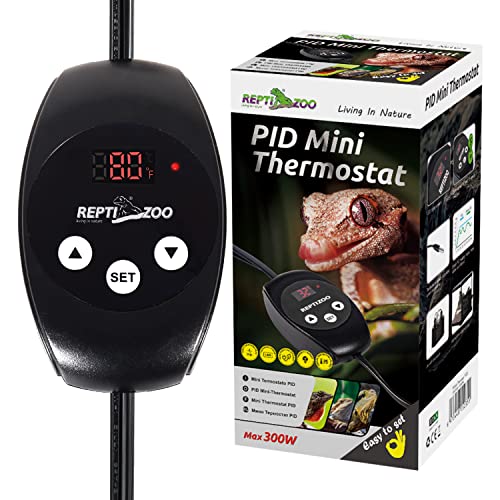
REPTIZOO’s dimming thermostat emphasizes precise temperature control with a memory function, ideal for heat lamps and smart PID heating. The device supports a constant temperature range from 41°F to 140°F (5°C to 60°C) and provides a clear LED display. It’s designed for bearded dragons, geckos, and other reptiles, offering a stable environment and longer bulb life by reducing temperature fluctuations. It is suitable for be a be an efficient choice for bulb-based heating setups.
CAVACHEW Dimming Thermostat

CAVACHEW provides an efficient PID-based dimming thermostat for reptile heat lamps and mats, with a memory function to restore prior settings after power cycles. It monitors ambient temperature with a high-sensitivity probe and maintains a constant range from 68°F to 122°F (20°C to 50°C). Its robust design supports up to 300W loads, making it a suitable option for bearded dragons, geckos, snakes, and other reptiles.
Buying Guide
- Temperature range and sensor accuracy: Look for controllers offering precise sensing and a range that covers your target environment. Reptile habitats and seedling mats benefit from tight control to avoid stress or stress-related growth issues.
- Relays and load capacity: Ensure the device can handle the wattage of your heat lamps or mats. Overloading can trigger safety features or fail prematurely.
- Model features: Dimming vs. on/off, memory functions, and dual-relay ability influence stability and convenience, especially during power interruptions or when both heating and cooling are needed.
- Ease of use: Simple interfaces, clear displays, and straightforward wiring lessen setup time and mistakes, particularly for hobbyists and beginners.
- Durability and suitability: Consider enclosure material (fire-retardant shells), wet-dry suitability, and whether the device is designed for dry indoor use or specialized environments.
- Versatility: A controller that works with multiple heating devices (heat lamps, mats, incubators) offers flexibility if you manage different projects or species.
- Safety: Look for features like automatic shutoff at preset thresholds, surge protection, and clear indicator lights to reduce risk in heating applications.
- Installation considerations: Placement of the temperature probe is critical. Position it away from direct heat sources to get a true ambient reading for stable control.
When selecting a thermostat for a heat lamp, balance precision, simplicity, and compatibility with your equipment. For reptile care, prioritize stable temperatures and safe monitoring; for plant propagation and seed germination, emphasize uniform warmth and reliable power backup. Always follow manufacturer installation instructions and ensure compliance with local electrical codes for safe operation.