Home ventilation systems help remove moisture, odors, and pollutants while bringing in fresh outdoor air. This article reviews five well-regarded options for American homes, highlighting how they balance energy efficiency with improved indoor air quality. Each product is described with its standout features, usage scenarios, and suitability for different climates and spaces.
Summary of chosen products:
| Product | Brand | Key Benefit | Typical Use |
|---|---|---|---|
| FV-10VEC2 Intelli-Balance 100 | Panasonic | Cold climate ERV with adjustable airflow | Homes in cold areas |
| FV-10VE2 Intelli-Balance 100 | Panasonic | Temperate climate ERV with Boost and timer | Temperate climates and year-round ventilation |
| VT501 Heat Recovery Ventilation Fan | Weiworld | Ceramic heat recovery, WiFi remote control | Residential garages, attics, and living spaces |
| AIRTAP T4 Register Booster | AC Infinity | Boosts airflow through 4” x 10” registers | Existing HVAC systems with register gaps |
| Fresh Air Whole House Vent System | VallisCo | Quiet, remote-controlled whole-house ventilation | Homes needing whole-house air exchange |
Panasonic Intelli-Balance 100 ERV (FV-10VEC2)

The FV-10VEC2 model is designed for cold climates, balancing moisture and fresh air while maintaining indoor air pressure. It includes a MERV 8 filter to capture common particulates and uses two DC/ECM motors with a Pick-A-Flow selector ranging from 30 to 100 CFM. A Boost function can temporarily push airflow to 100 CFM, and a timer provides control over runtime. This configuration aims to minimize energy losses while ensuring a steady air exchange in homes where winter indoor humidity can be an issue.
Key considerations for this system include suitability for very cold locations (down to -22°F / -30°C), the need for a controlled air supply and exhaust, and the potential to integrate with existing building management or simple wall controls. Users should plan for proper intake and exhaust routing to maximize the ERV’s effectiveness and ensure filters are accessible for periodic replacement.
Panasonic Intelli-Balance 100 ERV (FV-10VE2)

The FV-10VE2 model covers temperate climates and provides the same dual-DC/ECM motor architecture with Pick-A-Flow from 30 to 100 CFM. It includes a Boost function for quick air exchange and a timer to tailor operation to daily routines. While not as aggressively cold-weather focused as the VEC2, this unit offers reliable energy recovery and steady performance across milder winters and moderate humidity levels. This makes it a versatile choice for many American homes seeking balanced ventilation year-round.
Deciding between the VEC2 and VE2 often hinges on your climate and energy goals. If you experience very cold winters, the VEC2’s cold climate optimization can be advantageous. For homes in temperate zones, the VE2 provides a strong blend of energy recovery and flexible control without over-specification for extreme cold.
Weiworld VT501 Heat Recovery Ventilation Fan
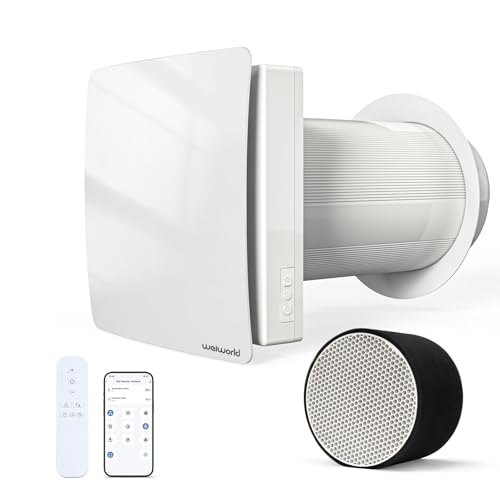
The VT501 is a wall-mounted heat recovery ventilation system that uses a ceramic core to recover up to 90% of heat from exhaust air to preheat incoming fresh air, significantly reducing heating energy needs. It supports WiFi and remote control via an app, enabling scheduling and mode changes from anywhere. Three operating modes—fresh air intake, exhaust, and recirculation—allow flexible ventilation strategies to match daily routines and seasonal changes. This unit is well-suited for spaces where ducting to a central system is not ideal but where steady, controllable air exchange is desired.
Key considerations include the integration of a WiFi interface, ensuring appropriate wall space for mounting, and ensuring the unit’s ceramic core is properly sized for the space. While the VT501 emphasizes heat recovery, users should evaluate noise levels, installation clearances, and the required intake/exhaust routing to optimize performance.
AC Infinity AIRTAP T4 Register Booster

The AIRTAP T4 is a register booster fan designed to improve airflow through 4” x 10” register openings. It features a smart controller with 10 speed levels, heating/cooling triggers, and timer/cycle programming. Bluetooth app connectivity enables remote control, alarms, and climate data readouts. This option is ideal for retrofitting existing ducted systems where a quiet, controllable boost in supply air is needed without major ductwork changes. It complements whole-house ventilation by enhancing localized air distribution in rooms with weak supply.
Considerations include compatibility with your current register size, noise tolerance at higher speeds, and whether the booster should be used continuously or intermittently. App-based monitoring can help optimize timing to avoid excessive energy use while maintaining comfort.
VallisCo Fresh Air Whole House Ventilation System

The VallisCo system offers remote control and a quiet operation profile with an EC motor and four-speed airflow adjustment. It supports a 4-hour timer for scheduling and can deliver up to 190 CFM, suitable for larger homes or office spaces. This model emphasizes balanced whole-house air exchange, targeting improved indoor air quality without introducing significant noise or air drafts. It is positioned as a standalone whole-house solution, potentially replacing or augmenting traditional exhaust fans in areas like basements and living spaces.
Key considerations involve the size of the space to be ventilated, the desired balance between intake and exhaust, and the remote control experience. The system’s remote and timer features provide flexibility, but correct ducting and filter maintenance remain essential for optimal performance.
Buying Guide: Key Purchase Considerations And Comparisons
- Climate suitability: Cold-climate ERVs (like Panasonic FV-10VEC2) are optimized for extreme winter humidity and heat exchange. Temperate models (FV-10VE2) work well across milder winters. Determine your local climate to pick the right ERV capacity and recovery strategy.
- Airflow control: Look for adjustable CFM ranges (30–100 CFM is common) and Boost or high-speed settings to handle occupancy changes, kitchen activity, or seasonal ventilation needs.
- Filtration: A MERV 8 filter is common; higher filtration demands can benefit from more robust filtration, especially in dusty environments. Consider filter access and replacement frequency.
- Energy recovery: Heat or energy recovery components (ceramic cores or similar) improve efficiency by transferring heat between exhaust and incoming air, reducing heating or cooling loads.
- Remote control and smart features: WiFi, Bluetooth, and app integration (as with Weiworld and VallisCo products) offer scheduling, monitoring, and alerts, which can improve energy management and user convenience.
- Installation considerations: Wall-mounted units, through-wall installations, or attic placements each require appropriate clearances, electrical connections, and ducting. Ensure you have space for intake/exhaust routing and accessible service.
- Noise and comfort: Noise levels (often expressed in dB) matter for living spaces. Look for quiet operation at typical speeds and consider vibration isolation and duct design to minimize sound propagation.
- Maintenance: Regular filter changes, core cleaning (where applicable), and motor/ fan inspections extend system life. Consider models with easy access to components for maintenance.
- Whole-house versus room-by-room: If air quality is a concern across the entire home, a dedicated whole-house system (like VallisCo) may be preferable. For targeted improvement in specific rooms, booster fans or smaller wall units can be used in combination with existing HVAC.
Overall, the best choice depends on climate, home size, existing ductwork, and desired control level. ERVs are especially beneficial in homes with humidity concerns and energy efficiency goals, while booster fans and smaller wall-mounted units can optimize airflow in particular zones. A balanced approach—combining a robust central ventilation with localized enhancements—often yields the most reliable indoor air quality improvements.