Restaurant ventilation is essential for maintaining a healthy, comfortable dining and kitchen environment. This guide reviews select ventilation and exhaust options that balance performance, energy efficiency, and compliance with common safety standards. The featured products cover residential ERVs suitable for smaller spaces to heavy-duty commercial exhaust fans designed for busy kitchens. Use this overview to compare airflow, noise levels, installation requirements, and overall value for modern American restaurants.
Summary of Selected Products
| Product | Brand | Key Features | Link |
|---|---|---|---|
| Broan B210E75RS AI 206 CFM ERV | Broan-NuTone | VIRTUO airflow verification, auto-balancing, self-adjustment, tempered outdoor air, improved indoor air quality | View |
| CAPTIVE-AIRE Upblast Exhaust Fan DU85HFA | CAPTIVE-AIRE | High speed centrifugal, grease-rated, 1500-2200 CFM, 0.75 HP, includes grease cup and installation aids | View |
| CAPTIVE-AIRE Upblast Exhaust Fan DU12HFA | CAPTIVE-AIRE | Grease-rated, 100-500 CFM, compact 19″ base, 0.180 HP, includes mounting components | View |
| VallisCo 6″ Inline Duct Fan | VallisCo | 350 CFM, EC motor, quiet operation, variable speed control | View |
| MARS HYDRO 6″ Smart Inline Fan Combo | MARS HYDRO | Up to 402 CFM, PWM EC motor, smart app with alarms and climate triggers, odor filtration | View |
The table highlights a mix of ERV and high-capacity exhaust options suitable for American restaurant environments. Consider space constraints, regulatory requirements, and energy efficiency when choosing a system for your venue.
Broan-NuTone ERV With Auto-Balancing

The Broan B210E75RS AI 206 CFM ERV integrates modern energy recovery technology with VIRTUO airflow verification. It is designed to supply tempered, filtered outdoor air while exhausting stale indoor air, thereby enhancing indoor air quality and occupant comfort. Its auto-balancing and self-adjustment features help maintain the intended air distribution across different dwelling types, which translates well to mixed-use restaurant spaces or small commercial kitchens where precise control is beneficial. Installation remains streamlined thanks to automated verification that reduces manual balancing tasks.
Key considerations: suitability for mid-sized kitchens and dining areas, energy recovery efficiency, and maintainability. Its 206 CFM rating suits smaller footprints or supplemental ventilation in conjunction with rooftop or wall-mounted systems. Noise and energy consumption should be weighed against the benefits of continuous, temperate air exchange, especially in regions with extreme climates.
CAPTIVE-AIRE Upblast Exhaust Fan DU85HFA
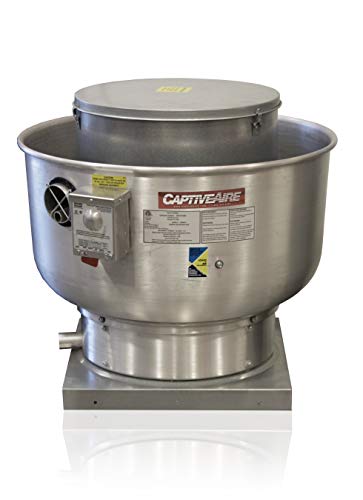
This high-speed, direct-drive centrifugal upblast exhaust fan is built for demanding restaurant environments. With a 24 3/4″ wheel and a capacity range of 1500-2200 CFM, it is well-suited for grease-laden kitchens needing robust exhaust capability. The 0.75 HP, 115V motor delivers strong performance, and included accessories like the grease cup, down spout, and hinge kit simplify rooftop curb integration. It carries UL705, UL762, and ULC-S645 ratings, ensuring compliance with common fire and safety standards for commercial kitchens.
Considerations include installation footprint, vibration and noise at higher CFM, and the necessity of upstream ducting size. For high-traffic kitchens with heavy grease loads, this model provides the reliability required to manage smoke and heat efficiently. It pairs well with a corresponding makeup air solution for balanced ventilation.
CAPTIVE-AIRE Upblast Exhaust Fan DU12HFA
The DU12HFA provides a compact 19″ base footprint with a 100-500 CFM range and a 0.180 HP 115V motor, making it suitable for smaller cooking lines or auxiliary exhaust needs within a canopy hood system. It is grease-rated and includes essential installation components for a straightforward rooftop or canopy mounting. The UL705, UL762, and ULC-S645 compliance ensures it meets restaurant safety standards while offering a quieter operation in a smaller form factor.
Local shop considerations include matching the base dimensions with existing hoods and roof curbs, ensuring adequate backdraft protection, and planning for future expansion if the kitchen grows. This unit is ideal when a kitchen requires reliable exhaust without over-sizing the system.
VallisCo Inline Duct Fan With EC Motor

The VallisCo 6″ inline duct fan delivers up to 350 CFM with a quiet operation profile (below 30 dB) and an energy-saving EC motor. The variable speed control allows operators to fine-tune airflow to kitchen and dining needs, balancing grease management with energy efficiency. This unit is suitable as a supplementary inline fan for makeup air systems or for replacing aging inline fans in compact restaurants where space is limited.
Key considerations include compatibility with existing ductwork, insulation needs for noisy environments, and long-term energy savings from the EC motor. For venues with variable occupancy or outdoor conditions, the motor’s efficiency and speed adjustability offer practical value.
MARS HYDRO 6 Inch Smart Inline Fan Combo

The Mars Hydro iFresh inline fan combines a 6-inch duct with a PWM EC-powered motor and a smart app for remote control. It supports up to 402 CFM, offering robust ventilation for kitchens or grow environments adjacent to restaurant spaces that require odor management and programmable airflow. The unit’s activated carbon filtration helps reduce odors, supported by a washable pre-filter to protect the carbon media and extend service life. The OTA app features alarms and climate triggers for proactive maintenance and performance adjustments.
Considerations include software reliability, potential Wi-Fi dependence, and the balance between higher CFM and the need for quiet operation in dining zones. This option is particularly appealing for restaurants with adjacent grow facilities or where odor control is a priority beyond basic exhaust needs.
Buying Guide: Key Purchase Considerations
- Ventilation goals: Define primary objectives—smoke control, odor removal, humidity management, or overall IAQ improvement. ERVs help with energy recovery, while high-CFM exhaust fans rapidly remove heat and grease-laden air.
- Ventilation capacity: Calculate required CFM based on kitchen load, dining area occupancy, and equipment. Oversizing can waste energy; undersizing reduces comfort and safety.
- Energy efficiency: Prioritize EC motors and energy recovery features where possible. These reduce operating costs and align with green initiatives.
- Noise considerations: Louder fans affect dining comfort. Look for models with sound attenuation or adjustable speed control to balance performance with noise levels.
- Compliance and safety: Ensure units meet UL or ULc standards, UL705/UL762 ratings for exhaust devices, and appropriate fire/smoke ratings for kitchen environments.
- Installation and space: Assess mounting options (wall, ceiling, rooftop), duct size compatibility, and integration with existing hoods and makeup air systems.
- Maintenance: Prefer equipment with accessible components, easy cleanability, and long filter life. Consider serviceability for grease-rich kitchens.
- Controls and automation: Auto-balancing, smart controls, and app-based monitoring can simplify operation and improve IAQ consistency across shifts.
- Resilience and support: Choose brands with robust warranty coverage and a reliable service network to minimize downtime.
In practice, a mixed solution often works best: a reliable rooftop or wall-mounted exhaust for rapid air exchange, paired with an ERV or energy-efficient inline fans to maintain comfortable, healthy indoor air while controlling energy costs. When designing a system for a restaurant, collaborate with a qualified HVAC contractor to ensure appropriate sizing, duct routing, and code compliance for your location and kitchen layout.