Choosing the right wireless thermostat for a boiler can improve comfort, energy efficiency, and overall home control. This guide highlights five top options, balancing ease of installation, compatibility with boiler setups, and smart features. Each product section includes key capabilities, wiring considerations, and practical usage notes to help you pick the best fit for your heating needs.
| Product | Brand | Notes |
|---|---|---|
| Honeywell YTH6320R1001 | Honeywell | Redlink enabled, focusPRO kit |
| Braeburn 7500 Universal Wireless | Braeburn | 7-day options, flexible wiring |
| Sensi Smart Thermostat ST55 | Emerson | Wi‑Fi, energy savings |
| DIGITEN WTC100 Pro | DIGITEN | Plug-in, remote control outlet |
| Honeywell TH1100DV1000 Pro-Digital | Honeywell | Two-wire heat-only |
Honeywell YTH6320R1001 FocusPro Wireless Thermostat Kit

Honeywell’s YTH6320R1001 is a programmable, wireless FocusPro kit designed for reliable boiler integration via RedLINK wireless technology. It uses an Equipment Interface Module (EIM) to connect all HVAC equipment, with a return air sensor that helps maintain safe indoor temperatures if power is interrupted. This setup is well-suited for forced-air or hydronic boiler systems that require consistent temperature control and robust wireless communication. The kit emphasizes reliability, with a focus on maintaining setpoints during outages, which can be important for boiler-based heating zones.
Key considerations include ensuring compatibility with your boiler’s wiring and the EIM’s role in your system. While it offers wireless flexibility, some installations may benefit from professional setup to align with zoning strategies and to verify sensor placement for optimal boiler performance. RedLINK reliability means less interference and stable control across multiple devices in the home.
Braeburn 7500 Universal Wireless Thermostat

The Braeburn 7500 is a versatile wireless thermostat that supports seven-day programming, with options for 5-2 day or non-programmable modes. It offers auto or manual changeover and supports residential or commercial modes. The unit operates on batteries for flexible placement and is compatible with 2- or 3-wire hydronic zone systems, making it adaptable for boiler-based heating layouts. Features like 24-volt operation via R and C terminals enable optional integration with traditional boiler controls and zone controllers.
When evaluating for a boiler setup, consider the zone configuration and whether the thermostat needs to communicate with a central boiler control or a separate zone panel. The large, backlit display enhances readability in dim boiler rooms or hallways. Its broad compatibility makes it a solid option for upgrading older boiler systems to a more modern, wireless control scheme.
DIGITEN Wireless Thermostat Outlet WTC100 Pro

The DIGITEN WTC100 Pro is a plug-in wireless thermostat outlet designed for heating and cooling devices that plug into a standard outlet. It simplifies control without complex programming, letting you switch between Celsius and Fahrenheit, and supports remote operation through a built-in sensor. This unit is a practical choice for turning space heaters, fans, or AC units on or off with a target temperature. It’s especially useful for zones or rooms that lack a dedicated thermostat, providing a low-cost entry into wireless temperature management for boiler-adjacent heating zones.
Pros include plug-and-play setup and safety-conscious design features like separate input and output sockets to reduce current-related heat rise. However, it’s essential to recognize that this is not a full boiler control solution; it is best used as a supplemental control for auxiliary heating devices in a boiler-dominant system. Ensure your boiler’s control strategy supports additional wired or wireless inputs as needed.
Honeywell Home Wireless Programmable FocusPRO Kit

This Honeywell FocusPRO kit with a wireless adapter is designed for use with TrueZONE panels, expanding flexibility in boiler and radiant heating environments. The kit’s goal is to enable wireless communication while maintaining reliable temperature control across multiple zones. The packaging notes its origin in the United States and provides practical weight and dimension data, useful for installers planning equipment placement and network layout. The kit’s core benefit is integrating wireless operation into established boiler and zoning configurations without sacrificing control precision.
Considerations for boiler users include compatibility with TrueZONE or similar zoning systems, ensuring the wireless adapter integrates with existing crash-free control loops, and confirming required power for the wireless network. This option can help expand a boiler-based system into a more scalable, multi-zone solution with remote access simplified by wireless connectivity.
Sensi Smart Thermostat ST55
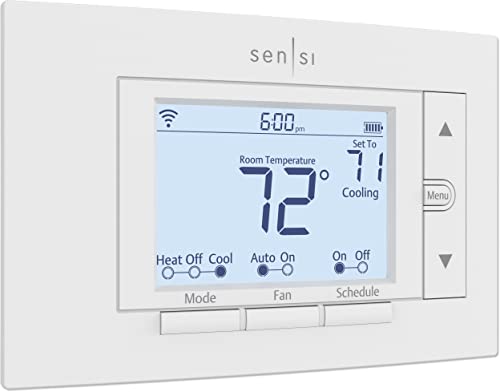
The Sensi ST55 is a Wi-Fi enabled smart thermostat designed for easy DIY installation in many homes. It emphasizes privacy, with claims that Sensi won’t sell personal information. The thermostat offers flexible scheduling, remote access via a mobile app, and usage reports to support energy-saving decisions. It’s compatible with various HVAC systems, and in many installations, a common wire is not required. Samsung-like energy-saving features are highlighted by Energy Star certification and the potential to reduce HVAC energy consumption by approximately 23% in typical usage scenarios.
For boiler-centric homes, Sensi provides straightforward integration and user-friendly setup, which can be beneficial for homeowners who want a modern thermostat without a heavy installation process. The lack of mandatory wiring complexity makes it a strong option for renters or houses where boiler zones are less complex. Ensure compatibility with your boiler’s controls and confirm that the C-wire is available if remote sensing or power-stealing operation is not desired.
Honeywell TH1100DV1000 Pro-Digital Two-Wire Heat Only

The TH1100DV1000 is a two-wire digital thermostat aimed at heat-only boiler systems. It features an adjustable temperature scale from 40 to 90 F, and a backlit display for easy reading in boiler rooms or dim hallways. The device emphasizes straightforward operation and reliable performance for single-stage heating setups. Its simplicity can be advantageous for older boiler systems that require a basic, no-fuss control solution.
When considering this option, verify compatibility with your boiler’s electrical configuration and zone controls. Two-wire installation can limit additional features, so pairing with a compatible zone controller or a wireless module may be needed to achieve multi-room comfort or more advanced scheduling. The TH1100DV1000 remains a solid option for traditional boiler setups seeking a dependable, easy-to-use thermostat.
Buying Guide: Key Purchase Considerations for Wireless Thermostats With Boilers
- Compatibility: Confirm boiler compatibility, wiring (2-wire vs. 4-wire), zone control needs, and whether the thermostat supports hydronic or radiant heat integration.
- Wiring and power: Decide between battery-powered wireless options and those requiring a C-wire or power adapters. For boilers, reliable control often benefits from wired connections to central controllers or zone panels.
- Wireless reliability: Look for devices with robust wireless protocols (e.g., RedLINK, Wi‑Fi with secure pairing) and minimal interference. Consider the size of your home and potential signal barriers.
- Programming vs. non-programmable: If you prefer automation, choose 5-2 or seven-day programming. For simpler setups or temporary configurations, non-programmable outlets or plug-in solutions can be adequate.
- Energy efficiency: ENERGY STAR or energy-saving features, remote access, usage reports, and adaptive schedules can help reduce boiler fuel consumption and improve comfort.
- Installation and support: Some products are best installed by professionals, especially when integrating with zoning panels or complex boiler systems. Review mounting options, sensor placement, and warranty details.
- Extendability: Consider whether you want additional sensors, wireless adapters, or compatibility with smart home ecosystems (Alexa, Google Assistant) for future expansion.
- Safety and sensors: For boiler areas, ensure sensors and thermostats are installed away from heat sources that could skew readings. Safety features like power loss protection can help maintain safe temperatures.